Understand your material
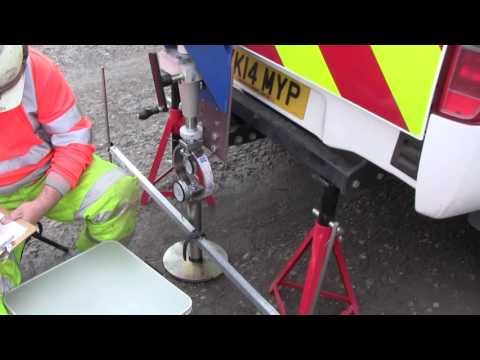
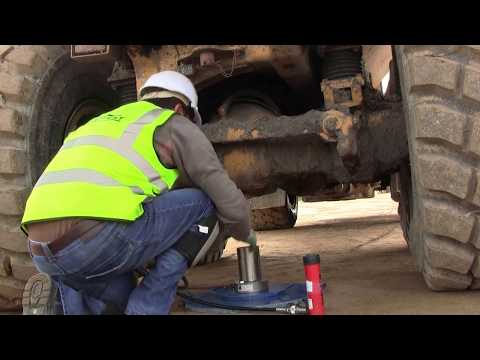
Assess ground settlement under an applied load for pavements, working platforms and earthworks.
Ground testing & bearing capacity
Assess ground settlement under an applied load for pavements, working platforms and earthworks.
Same-day & next-day testing dates available. Call to check availability for your location and test requirements.
Practical testing. Experienced people. A service built around your project.
Quality, safety & professional standards
UKAS accreditation applies to the tests listed in our accredited schedule.
View our credentials ↗


Experienced people
Technical knowledge, with practical advice.
National coverage
Testing support wherever your project takes you.
A responsive service
Clear arrangements, from enquiry to reporting.
The right testing for your project
Practical advice, experienced testing staff and clear reporting. Assess ground settlement under an applied load for pavements, working platforms and earthworks.
Speak to the team ↗Where this service helps
The right test helps answer a specific project question. We’ll agree the method and requirements with you before the work begins.
Assess ground settlement under an applied load for pavements, working platforms and earthworks.
Agree the test method, sample condition and acceptance criteria before the work begins.
Use clear test records to support your project’s material and engineering assessment.
Plate diameter, loading cycles and reaction load are selected to suit the material and the purpose of the test. Where a derived CBR is required, agree the calculation and its suitability with the project engineer; it is distinct from a direct plunger CBR test.

A closer look
Plate diameter, loading cycles and reaction load are selected to suit the material and the purpose of the test. Where a derived CBR is required, agree the calculation and its suitability with the project engineer; it is distinct from a direct plunger CBR test.
UKAS accreditation applies to the particular methods listed in Hixtra’s current schedule, rather than every service. Ask us to confirm the accreditation status of the testing you require.
Hixtra in action
Working with Hixtra
From your first enquiry to your report, you’ll have practical advice on what to book, how to prepare and what happens next.
Share the site location, materials and testing specification. If you are unsure which test you need, we can help.
We agree the scope, access or sample requirements, availability and reporting arrangements before work starts.
Your results are reported for the agreed testing. Our team is on hand if you need to discuss the report.
Testing support across England & Wales
From individual site visits to ongoing testing programmes, we support construction, civil engineering and geotechnical projects across England and Wales.
Check availability for your site ↗Your questions
Practical answers on what this test is for, how to prepare and what you get back.
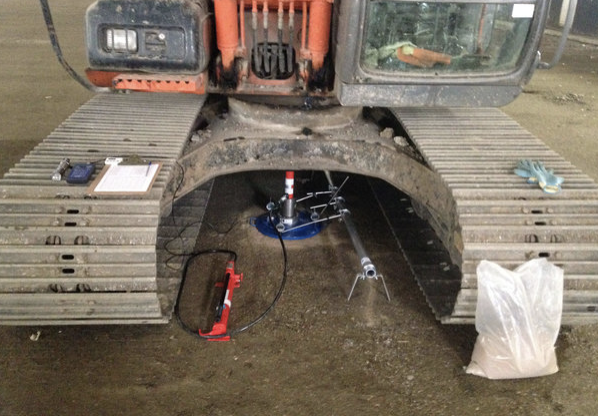
Ask us about your project →It measures how much the ground settles under a known load applied through a rigid circular plate. Load is applied in increments by a hydraulic jack reacting against a heavy machine, and the settlement is recorded at each stage. The output is a load and settlement relationship, from which a bearing pressure, a stiffness modulus or a derived CBR can be calculated depending on what the design needs.
Plate bearing tests are usually carried out to the plate loading method described in BS 1377-9, with the plate size, load increments and maximum applied pressure set by your specification. Where the test is checking a working platform, the target pressures come from the platform design, now normally prepared to the Temporary Works Forum guidance on granular working platforms, with some specifications still naming the earlier BRE report BR 470. Tell us what the result has to demonstrate and we will confirm the method before booking.
Use a plate bearing test when you need settlement under a known static load, or when the material is too coarse for a plunger CBR. The plate applies a sustained load close to the stress the real plant or structure will impose, which is why it suits working platforms, crane and piling positions and thick granular layers. Material containing stone over 20 mm usually rules out a direct plunger CBR, and a plate test with an agreed derived calculation is then the sensible route.
Plates of 300, 450, 600 and 760 mm diameter are commonly used, and the choice controls how deep the test reaches. As a rule of thumb a plate stresses a depth of ground roughly twice its diameter, so a 600 mm plate is assessing over a metre of material rather than just the surface. Larger plates need more reaction load, so the plate is chosen from the layer you need to assess and the design pressure.
You will normally need to provide a machine heavy enough to resist the full test load without lifting, usually a tracked excavator. The weight required depends on the plate diameter and the maximum pressure being applied, so a small plate at low pressure needs far less than a 600 mm plate loaded to working platform pressures. We confirm the size of machine and the operator time to allow when the work is booked.
The position needs to be level, trimmed flat and clear of loose material at the exact level you want tested. A plate that is not bedded evenly gives settlement readings that reflect the seating rather than the ground, so we bed it on a thin layer of sand where the surface is uneven. Standing water, a formation softened by rain or ground churned up by tracking will all show in the result.
That depends on the area, how variable the ground is and what your specification asks for. Positions are normally spread to cover each material type and each part of the area being signed off, with extra tests where the ground looks weaker or the plant loads are highest. For a working platform or a crane position they usually sit under the intended footprint rather than at random. Send a layout plan and we will suggest a sensible number.
Allow roughly an hour per position for a standard test, covering setting up the plate, the loading cycles and repositioning the reaction machine. A longer sequence with several load and unload cycles, or higher pressures on a large plate, takes more. Several positions can usually be completed in a day, and the limit is normally how quickly the excavator can be moved and reset rather than the test itself.
The report gives the applied load and the settlement recorded at each increment for every position, presented as a load and settlement plot, with the plate diameter used, the test level and a description of the material. Where a modulus or a derived CBR has been agreed, the calculation behind it is stated so the reader can see how the figure was reached. Any deviation from the specified method is recorded.
Damage is minor. The plate leaves a shallow impression and the bedding sand stays behind, and where the test is done in a pit that excavation needs backfilling and compacting once we have finished. The tested spot is disturbed by the loading, so a repeat test is offset slightly rather than done in the same footprint. Tracked plant moving across a soft formation usually does more damage than the test does.
Hixtra holds UKAS accreditation to ISO/IEC 17025 for the tests listed in its schedule of accreditation, number 8996. Accreditation is specific to the listed methods and scope, so it covers particular methods rather than every service we offer. Ask us to confirm whether the plate bearing testing you need is covered before you book, and we will say plainly if any part of the work sits outside the schedule.
Cost is driven by the number of test positions, travel to site, the plate size and whether you can provide the reaction machine, plus any standby, out of hours working or traffic management the site needs. To price the work we need the site postcode, the number of positions, the design load or plate size if you know it, your preferred dates and the specification if there is one.
In our customers’ words
Independent feedback from the people we work with.
“Punctual, friendly and professional.”Read the full review ↗
“Perfect service and explained everything step by step.”Read the full review ↗
“Excellent service! Incredibly professional. Thankyou”Read the full review ↗
Customers come back to Hixtra
Read independent feedback from customers who have used our testing services.
4.8 / 5 on Trustpilot
“Punctual, friendly and professional.”
Lee Chippington · September 2026
Read this customer’s review ↗Same-day and next-day testing dates available. Tell us what you need and where, or call to check availability.