Understand your material
Determine the compressive strength of concrete cores recovered from an existing structure.
Concrete testing & coring
Determine the compressive strength of concrete cores recovered from an existing structure.
Same-day & next-day testing dates available. Call to check availability for your location and test requirements.

Practical testing. Experienced people. A service built around your project.
Quality, safety & professional standards
UKAS accreditation applies to the tests listed in our accredited schedule.
View our credentials ↗



Experienced people
Technical knowledge, with practical advice.
National coverage
Testing support wherever your project takes you.
A responsive service
Clear arrangements, from enquiry to reporting.
The right testing for your project
Practical advice, experienced testing staff and clear reporting. Determine the compressive strength of concrete cores recovered from an existing structure.
Speak to the team ↗Where this service helps
The right test helps answer a specific project question. We’ll agree the method and requirements with you before the work begins.
Determine the compressive strength of concrete cores recovered from an existing structure.
Agree the test method, sample condition and acceptance criteria before the work begins.
Use clear test records to support your project’s material and engineering assessment.
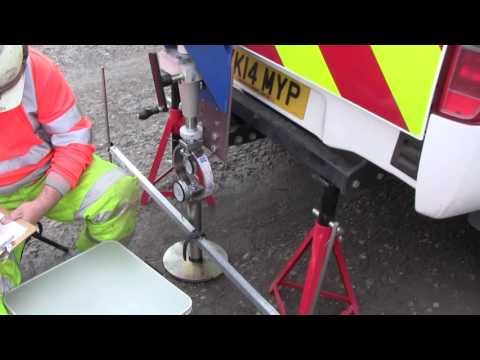
Cores are prepared to the required dimensions, with suitable end preparation and conditioning before compression testing. Supply the core location, orientation and investigation requirements. Interpretation should account for the sampling and test conditions as part of the engineering assessment.
Coring and core compressive strength testing are available across England and Wales. Hardened concrete is stable, so a core can travel to the Milton Keynes laboratory without the result being affected, and none of the radius that applies to fresh concrete work applies here. Distance changes what a site visit costs rather than whether we can attend. Tell us the postcode and the investigation requirements.

A closer look
Cores are prepared to the required dimensions, with suitable end preparation and conditioning before compression testing. Supply the core location, orientation and investigation requirements. Interpretation should account for the sampling and test conditions as part of the engineering assessment.
UKAS accreditation applies to the particular methods listed in Hixtra’s current schedule, rather than every service. Ask us to confirm the accreditation status of the testing you require.
Hixtra in action
Working with Hixtra
From your first enquiry to your report, you’ll have practical advice on what to book, how to prepare and what happens next.
Share the site location, materials and testing specification. If you are unsure which test you need, we can help.
We agree the scope, access or sample requirements, availability and reporting arrangements before work starts.
Your results are reported for the agreed testing. Our team is on hand if you need to discuss the report.
Testing support across England & Wales
From individual site visits to ongoing testing programmes, we support construction, civil engineering and geotechnical projects across England and Wales.
Check availability for your site ↗Your questions
Practical answers on what this test is for, how to prepare and what you get back.
Ask us about your project →It gives the compressive strength of the concrete as it actually exists in the structure, measured on a cylinder of concrete cut out of the element itself. Because that concrete was placed, compacted and cured in position, a core carries the effects of workmanship and site conditions in a way a standard cube does not. That makes coring the usual route when the question is what the built structure is achieving rather than what the supplied concrete could achieve.
Coring is normally used when cube results are missing, disputed or unrepresentative, or when there are no cubes at all because the concrete is already in service. Typical triggers are a low or failed cube result, an existing structure of unknown strength, a change of use or added loading, fire or impact damage and concrete suspected of being poorly compacted. It is also the route when a structure has to be assessed for something it was not originally designed for.
Taking, examining and testing cores is usually specified to BS EN 12504-1, with the compression test itself following BS EN 12390-3. Where the results are being used to judge the strength of the structure, the assessment normally follows BS EN 13791. Your specification may name something different, and we work to whatever it sets out. Send it across with the enquiry and we'll confirm the method before any drilling is arranged.
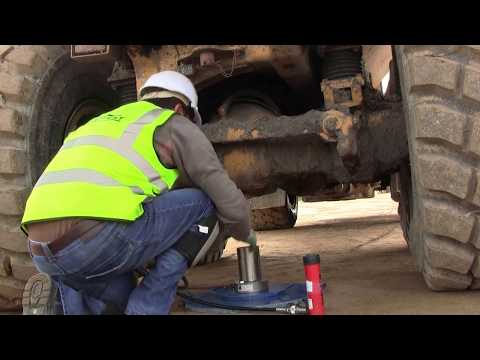
A water-cooled diamond barrel is drilled into the element from a rig anchored to the surface, with the water cooling the bit and flushing the cut. Drilling does disturb the specimen a little, which is one of the reasons a core reads lower than a cube of the same concrete, so a blunt bit, a rig that shifts or a core broken out roughly will all show in the strength. Positions, depths and reinstatement are agreed with the structural engineer before anything is cut.
Yes. Both the diameter and the trimmed length change the strength measured, which is why cores are cut and prepared to defined proportions. The diameter should be at least three and a half times the maximum aggregate size, with 100 mm the usual choice in the UK and 75 mm the practical minimum, because a narrow core relative to the stone gives scattered results. A length-to-diameter ratio of about 1 gives a result comparable with a cube, and about 2 one comparable with a cylinder.
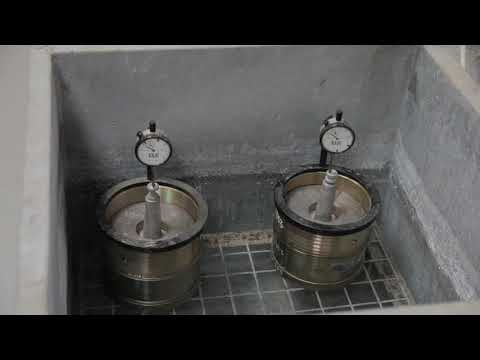
Each core is measured, examined and trimmed to the required length, then its ends are ground flat and square to the axis so the load is applied evenly. Grinding is preferred to capping, particularly on higher strength concrete. Cores are normally soaked in water at 20 ± 2 °C before testing, because the moisture condition affects the strength measured. The report records the dimensions, the length-to-diameter ratio, the moisture condition at test and any deviation from the method.
Cores are best taken clear of reinforcement, because bars crossing the specimen change the strength measured and add scatter to the results. Where a bar is unavoidable, its size and position are measured and recorded. BS EN 13791 treats a small amount of steel as acceptable, broadly under 2% by volume in a core tested at a ratio of 1, or confined to the outer 30 mm of one tested at 2. Scanning before drilling is the practical way to avoid the problem.
The number depends on what the result is being used for and how much of the structure is in question. A full structural assessment to BS EN 13791 needs at least eight valid results, so ten or more cores are usually drilled to allow for damaged or rejected specimens, while a small test region can be assessed on three. Positions are spread through the area concerned, away from edges, joints and congested reinforcement, and chosen so removing concrete does not weaken the element.
In-situ strength is normally lower than the standard cube strength for the same concrete, and there is no fixed conversion between the two. BS EN 13791 recognises this by setting its acceptance criteria for in-situ strength at a proportion of the specified characteristic strength, applying a factor of 0.85 rather than the full value. How the figures are interpreted remains an engineering judgement that has to account for the core geometry, the moisture condition, the age of the concrete and where the cores came from.
The report gives the core reference, where and when it was drilled, its orientation, a description of the concrete and any defects seen, the trimmed dimensions and length-to-diameter ratio, the moisture condition at test, the failure load and the calculated strength. Reinforcement found in the core is recorded with its size and position. Any departure from the method is stated, so whoever interprets the result can see the conditions the figure was produced under.
Hixtra holds UKAS accreditation to ISO/IEC 17025 for the tests listed in its schedule of accreditation, number 8996. Accreditation is specific to the listed methods and scope, so it covers particular methods rather than everything we do. Core work involves several separate activities, from drilling through preparation to the compression test, and they are not all covered in the same way. Ask us to confirm the status of the testing you need before booking.
Send the site postcode, how many cores are involved, their diameter and whether you want a cube-equivalent or cylinder-equivalent result, along with the specification if there is one. Tell us whether we are drilling the cores or you are sending cores already taken, and whether density is wanted on the same specimens. Cost is driven by the number of cores, the preparation each one needs and the access involved, plus any reinstatement or out-of-hours working.
In our customers’ words
Independent feedback from the people we work with.
“Punctual, friendly and professional.”Read the full review ↗
“Perfect service and explained everything step by step.”Read the full review ↗
“Excellent service! Incredibly professional. Thankyou”Read the full review ↗
Customers come back to Hixtra
Read independent feedback from customers who have used our testing services.
4.8 / 5 on Trustpilot
“Punctual, friendly and professional.”
Lee Chippington · September 2026
Read this customer’s review ↗Same-day and next-day testing dates available. Tell us what you need and where, or call to check availability.