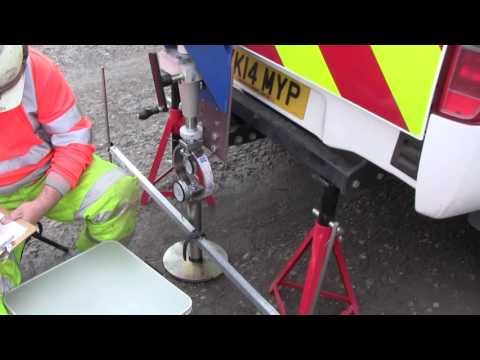
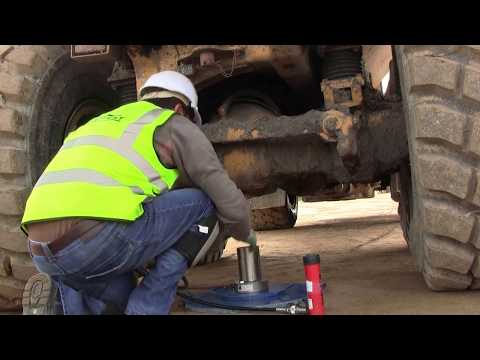
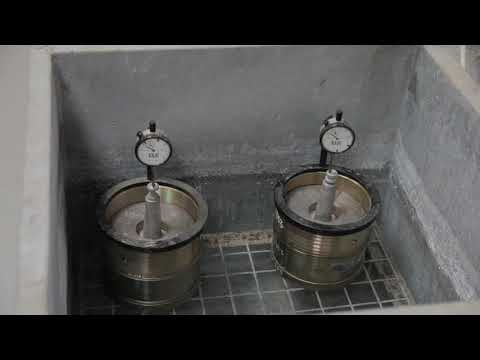
Understand your material
Recover cores and create controlled openings to investigate concrete, surfacing and underlying layers.
Concrete testing & coring
Recover cores and create controlled openings to investigate concrete, surfacing and underlying layers.
Same-day & next-day testing dates available. Call to check availability for your location and test requirements.
Practical testing. Experienced people. A service built around your project.
Quality, safety & professional standards
UKAS accreditation applies to the tests listed in our accredited schedule.
View our credentials ↗


Experienced people
Technical knowledge, with practical advice.
National coverage
Testing support wherever your project takes you.
A responsive service
Clear arrangements, from enquiry to reporting.
The right testing for your project
Practical advice, experienced testing staff and clear reporting. Recover cores and create controlled openings to investigate concrete, surfacing and underlying layers.
Speak to the team ↗Where this service helps
The right test helps answer a specific project question. We’ll agree the method and requirements with you before the work begins.
Recover cores and create controlled openings to investigate concrete, surfacing and underlying layers.
Agree the test method, sample condition and acceptance criteria before the work begins.
Use clear test records to support your project’s material and engineering assessment.
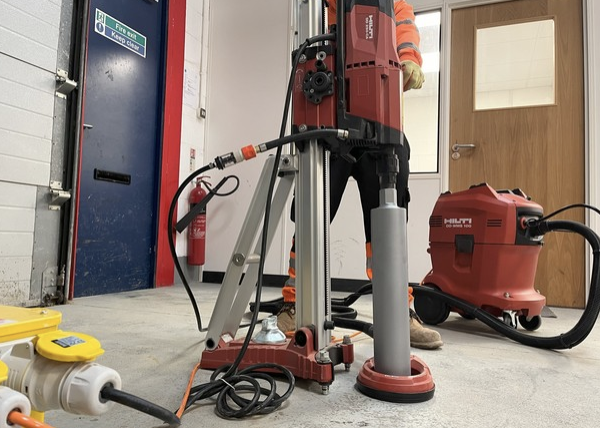
Hixtra provides portable diamond coring for projects in England and Wales. Applications include checking slab or pavement depth and exposing underlying material for further testing. Send dimensions, access details and service information so equipment, scanning and site preparations can be agreed.

A closer look
Hixtra provides portable diamond coring for projects in England and Wales. Applications include checking slab or pavement depth and exposing underlying material for further testing. Send dimensions, access details and service information so equipment, scanning and site preparations can be agreed.
UKAS accreditation applies to the particular methods listed in Hixtra’s current schedule, rather than every service. Ask us to confirm the accreditation status of the testing you require.
Hixtra in action
Working with Hixtra
From your first enquiry to your report, you’ll have practical advice on what to book, how to prepare and what happens next.
Share the site location, materials and testing specification. If you are unsure which test you need, we can help.
We agree the scope, access or sample requirements, availability and reporting arrangements before work starts.
Your results are reported for the agreed testing. Our team is on hand if you need to discuss the report.
Testing support across England & Wales
From individual site visits to ongoing testing programmes, we support construction, civil engineering and geotechnical projects across England and Wales.
Check availability for your site ↗Your questions
Practical answers on what this test is for, how to prepare and what you get back.
Ask us about your project →It cuts a clean, round hole through concrete, masonry, asphalt or stone using a diamond-tipped barrel, either to recover a core for examination and testing or to form an opening. Common uses are checking slab or pavement thickness, exposing the layers beneath a surface for further testing, recovering cores from an existing structure and putting services or drainage through a floor or wall. It cuts rather than hammers, so the surrounding concrete is not shaken about.
Everything from small anchor and resin-fixing holes of 20 to 30 mm up to openings of 350 mm and more, with the barrel and rig chosen to suit. Cores taken for strength assessment are usually 75 to 150 mm, because the standards want a diameter of at least three times the largest aggregate size. Depth is limited by the barrel length and by what sits behind the slab, so through-drilling a suspended floor needs the space underneath checked first.
Yes, every position is scanned before the barrel goes near it, using a covermeter or ground-penetrating radar to locate bars, ducts, conduits and voids, with positions moved slightly where that avoids cutting a bar. Scanning is not infallible in heavily congested or deep concrete, so drawings, as-built records and your own knowledge of what is in the slab matter as well. Post-tensioned slabs need particular care and should always be flagged before we attend.
Yes, and it needs to come from someone competent to give it. Cutting through a slab, beam or wall changes how the structure works, and severing reinforcement or a tendon can be serious, so the position, size and sequence should be agreed by your structural engineer or the building owner's engineer before we attend. We drill to an agreed and marked-out position. We do not decide whether an opening is structurally acceptable, and we will not cut without that confirmation.
Wet drilling is standard for concrete, because water cools the diamond segments, clears the cut and keeps dust down. The water is caught at the bit by a collection ring and vacuum, with bunding or mats where the floor must stay clean, and the slurry is collected for disposal rather than washed into a drain. Dry coring with on-tool extraction is used where water cannot be allowed near finishes, live services or occupied space below.
A 110 V site supply runs most of our handheld and small rig work, with larger core rigs needing 230 V or a generator. For water, a standpipe, tap or IBC within hose reach of the position is usually enough, and we can bring water where the site has none. Tell us how far the position is from the nearest supply and whether it is above ground floor, because hose and cable runs and lift or stair access affect how long the work takes.
Usually by an anchor bolt drilled into the slab or wall next to the core position, which is the most secure method and works on most surfaces. A vacuum base can be used on smooth, sound, flat concrete, and a jack or strut braced between floor and soffit suits positions where neither of those works. Anchor holes leave a small hole of their own, so tell us if the surface is finished or exposed.
Yes, by stitch drilling, which is a line of overlapping cores that cuts out a panel of almost any size or shape, including square and rectangular openings. Larger openings are often done as corner cores with saw cuts between them, which is quicker where a saw can reach. The section that comes out has to be supported, broken down or lifted away safely, so weight, headroom and a route off the floor all need thinking about beforehand.
Yes, and most of our work in occupied buildings is planned around when the space is free. Wet drilling produces very little airborne dust and dry work uses on-tool extraction, with sheeting and floor protection to keep the area clean. Noise is the bigger issue, because the vacuum and water pump carry and anchor fixing is percussive. Evening, night and weekend working is normally how this is handled, subject to any local authority restriction on hours.
That depends on what is agreed beforehand, so tell us at enquiry stage whether reinstatement is wanted and whether the cores are to be left with you. Small holes and anchor holes are commonly filled with a non-shrink grout or a resin mortar, and cores taken through surfacing can be reinstated with the appropriate material. Reinstating waterproofing, fire-stopping or a finished floor covering is specialist work and usually stays with the trade responsible for it.
Drilling is a site operation rather than a test, so the accreditation question normally applies to the testing carried out on the recovered cores. Hixtra holds UKAS accreditation to ISO/IEC 17025 for the tests listed in its schedule of accreditation, number 8996, and accreditation is specific to the listed methods and scope. Ask us to confirm whether the testing you need is covered. Coring for a strength assessment also has its own requirements for core size, position and handling.
The site postcode, the number of holes, their diameters and depths, the material being drilled and where the positions are in the building. Add access details, the floor level, available power and water, whether services or reinforcement are known to be present, the hours you need us to work and whether reinstatement is included. If the cores are going on for testing, say so, because that affects how they are cut and handled.
In our customers’ words
Independent feedback from the people we work with.
“Punctual, friendly and professional.”Read the full review ↗
“Perfect service and explained everything step by step.”Read the full review ↗
“Excellent service! Incredibly professional. Thankyou”Read the full review ↗
Customers come back to Hixtra
Read independent feedback from customers who have used our testing services.
4.8 / 5 on Trustpilot
“Punctual, friendly and professional.”
Lee Chippington · September 2026
Read this customer’s review ↗Same-day and next-day testing dates available. Tell us what you need and where, or call to check availability.