Cube compressive strength
Arrange concrete cube strength testing at the specified ages. Reliable sample identification, manufacture and curing are essential parts of the programme.
Hixtra · laboratory concrete testing
Laboratory testing of concrete specimens to support construction quality control and the investigation of existing structures. Here is what we cover and how to arrange it.
Talk to Hixtra →01908 505833Same-day & next-day testing dates available. Call to check availability for your location and test requirements.
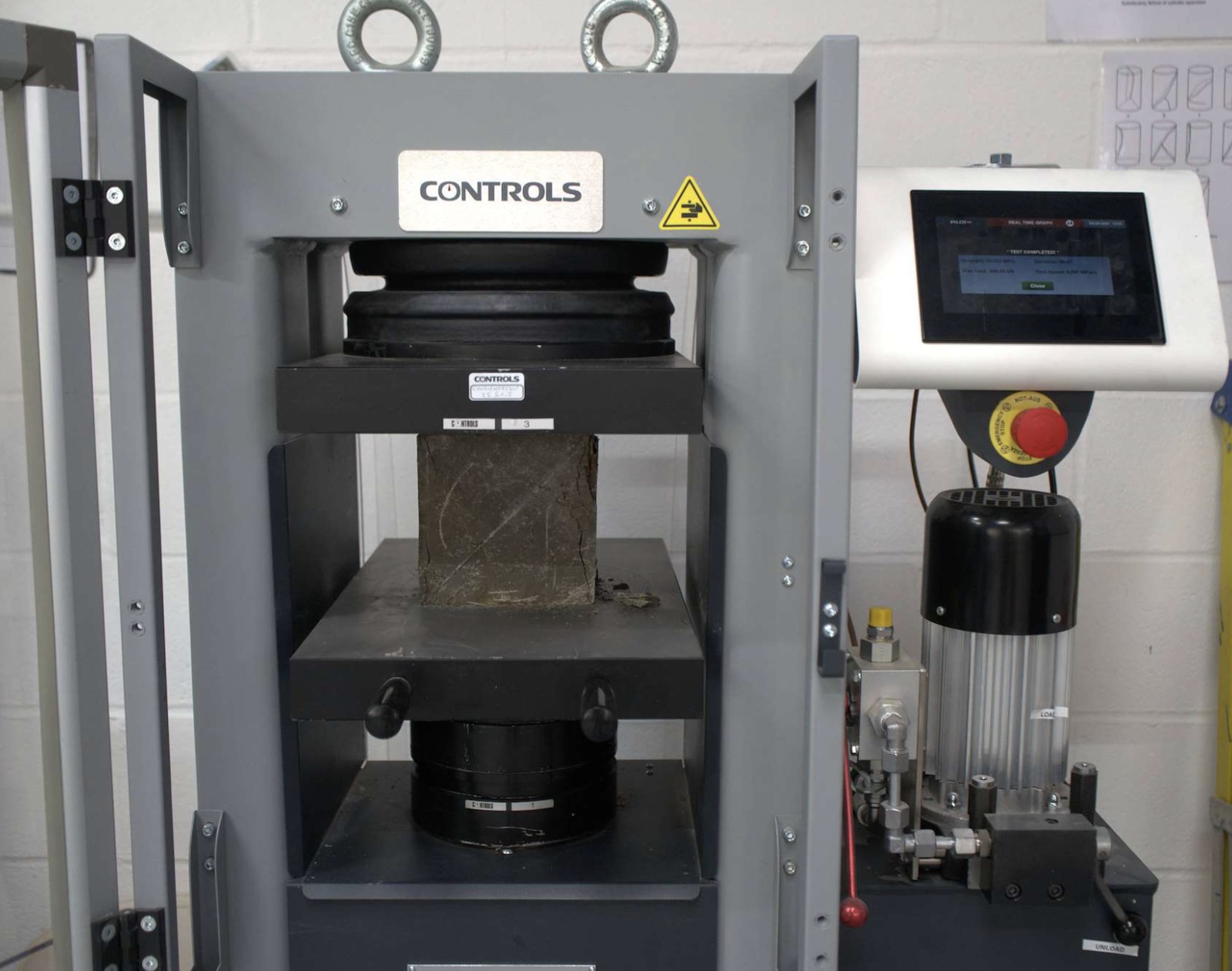
Concrete specimens tested against an agreed method and reporting scope.
Quality, safety & professional standards
UKAS accreditation applies to the tests listed in our accredited schedule. Ask us for the current scope before you book.
Understand our accreditation →



Reliable identification
Sample identification, manufacture and curing are tracked throughout.
Experienced people
Technical knowledge, with practical advice on the right test.
Clear reporting
The scope and reporting schedule are agreed before work proceeds.
Laboratory concrete testing
Hixtra provides laboratory testing of concrete specimens to support construction quality control and the investigation of existing structures.
Arrange concrete cube strength testing at the specified ages. Reliable sample identification, manufacture and curing are essential parts of the programme.
Concrete core testing provides strength measurements on prepared samples recovered from existing concrete. Send the investigation requirements and specimen details.
Our curing service maintains specimens under controlled conditions before testing. Hardened concrete density testing can be arranged where required for comparison or investigation.
Confirm specimen references, casting or sampling dates, testing ages, conditioning and delivery arrangements. We will agree the scope and reporting schedule before work proceeds.

Questions people ask
Practical answers for planning and booking laboratory concrete testing.
Ask us about your project →Cubes are typically tested at the ages set out in the specification, commonly 7 and 28 days. Tell us the required ages and we will agree the schedule before work proceeds.
Yes. Send the investigation requirements and specimen details, including how and where the cores were recovered, so we can prepare and test them correctly.
Yes, specimens can be maintained under controlled conditions before testing. This is arranged alongside the cube or core testing programme.
Confirm specimen references, casting or sampling dates, testing ages and conditioning history. Clear references avoid delays and mix-ups at the laboratory.
Where a method sits within our accredited schedule the report will say so. Ask us to confirm the accreditation status of each test before booking.
The cube is loaded to failure in a calibrated compression machine, and the compressive strength is the maximum load divided by the cross-sectional area, reported in newtons per square millimetre. Testing is usually specified to BS EN 12390-3. The report gives the specimen reference, the age at test, the dimensions, the failure load and the calculated strength. The failure pattern is also examined, because an unsatisfactory failure can point to a problem with the specimen rather than the concrete.
A 7-day result is an early indicator, not a substitute for the 28-day result, which is normally what conformity is judged on. As a rough guide a mix using CEM I reaches around two thirds of its 28-day strength by 7 days, but the proportion varies with cement type, additions, admixtures and curing temperature, and mixes containing fly ash or GGBS gain more of their strength later. Treat a low 7-day figure as a reason to check, not as a failure.
The first step is to check the specimen record rather than the structure. Identification, age at test, curing history, dimensions and failure pattern all affect the result, and a low figure sometimes comes from the cube rather than the concrete. If the result stands, the next moves belong to your engineer, and commonly include testing a companion cube at a later age, applying the identity testing criteria in BS EN 206 and BS 8500, or taking cores to assess the strength in place.
No. A cube is made, compacted and cured under standard conditions, so it shows what the concrete as supplied can achieve, while concrete in the structure is placed, compacted and cured in place and is normally weaker. Cube results are used to judge the conformity of the concrete supplied. Where the question is what the structure itself is achieving, in-situ strength is assessed from cores, using the approach set out in BS EN 13791.
A core is cut from concrete that has already hardened in place, so its result carries the effects of site compaction, curing and any damage caused by drilling. Core strength also depends on geometry. A length-to-diameter ratio of about 1 gives a result comparable with a cube and about 2 with a cylinder, so cores are prepared to a defined ratio with flat, square ends before testing. Cores are best taken clear of reinforcement, since bars crossing the specimen affect the strength measured.
100 mm cubes suit most structural concrete and 150 mm cubes are used where the aggregate is larger, because BS EN 12390-1 relates the specimen size to the maximum aggregate size. A concrete with 40 mm aggregate needs the 150 mm mould; a 20 mm mix does not. Keep to one size across a job so results are compared like with like, and check the specification first, since some contracts name the size. Tell us the maximum aggregate size and we'll confirm which mould to use.
We record the condition they arrive in, test them, and report the conditioning history alongside the result, with any deviation from the standard method stated. Standard curing is in water at 20 ± 2 °C, or in a chamber at the same temperature above 95% relative humidity. Specimens that have dried out, been allowed to freeze or been kept warm can give a result that does not represent the concrete, and we will tell you before they are tested.
Hardened density is worked out from the mass and volume of the specimen, usually to BS EN 12390-7, and is used as a check on compaction and on consistency between batches. It also confirms that a lightweight or heavyweight concrete meets its specified density, and it is useful supporting information when a strength result is being investigated. Density can be determined on the same cubes or cores as the strength test, so ask for it when the specimens are booked in.
Concrete cube testing by location
Cubes are cured and crushed at our laboratory in Milton Keynes wherever they are cast. These pages cover how cubes reach us from each area, whether we can attend the pour, and the local contact number.
Inside the fresh concrete radius, so our technicians can attend the pour and make the cubes.
01223 298718Cubes delivered, couriered or collected during a West Midlands site visit.
0121 270 6622Built for rolling programmes on multi storey frames, with every cube tracked by reference.
0161 871 7372Straight down the M1, with sulfate testing where the mudstone carries gypsum.
0115 786 5656City centre frames and the slower gaining mixes used at Avonmouth and Severnside.
0117 422 8206Basements, frames and piles, including the high GGBS mixes common on London Clay.
020 7993 5733We attend the pour, make the cubes and have them in controlled curing the same day.
01908 505833Housing and commercial work along the M3 and A34, plus marine concrete on the Solent.
01962 461501Keep reading
In our customers’ words
Independent feedback from the people we work with.
“Punctual, friendly and professional.”Read the full review →
“Perfect service and explained everything step by step.”Read the full review →
“Excellent service! Incredibly professional. Thankyou”Read the full review →