Understand your material
Use MCV testing to support assessment and control of soil suitability for earthworks.
Earthworks, compaction & stabilisation
Use MCV testing to support assessment and control of soil suitability for earthworks.
Same-day & next-day testing dates available. Call to check availability for your location and test requirements.
Practical testing. Experienced people. A service built around your project.
Quality, safety & professional standards
UKAS accreditation applies to the tests listed in our accredited schedule.
View our credentials ↗



Experienced people
Technical knowledge, with practical advice.
National coverage
Testing support wherever your project takes you.
A responsive service
Clear arrangements, from enquiry to reporting.
The right testing for your project
Practical advice, experienced testing staff and clear reporting. Use MCV testing to support assessment and control of soil suitability for earthworks.
Speak to the team ↗Where this service helps
The right test helps answer a specific project question. We’ll agree the method and requirements with you before the work begins.
Use MCV testing to support assessment and control of soil suitability for earthworks.
Agree the test method, sample condition and acceptance criteria before the work begins.
Use clear test records to support your project’s material and engineering assessment.
The test records compaction response under a prescribed sequence of blows. Testing specimens at different moisture contents can establish a moisture condition calibration for the soil. Agree the required method and limits within the earthworks specification.

A closer look
The test records compaction response under a prescribed sequence of blows. Testing specimens at different moisture contents can establish a moisture condition calibration for the soil. Agree the required method and limits within the earthworks specification.
UKAS accreditation applies to the particular methods listed in Hixtra’s current schedule, rather than every service. Ask us to confirm the accreditation status of the testing you require.
Hixtra in action
Working with Hixtra
From your first enquiry to your report, you’ll have practical advice on what to book, how to prepare and what happens next.
Share the site location, materials and testing specification. If you are unsure which test you need, we can help.
We agree the scope, access or sample requirements, availability and reporting arrangements before work starts.
Your results are reported for the agreed testing. Our team is on hand if you need to discuss the report.
Testing support across England & Wales
From individual site visits to ongoing testing programmes, we support construction, civil engineering and geotechnical projects across England and Wales.
Check availability for your site ↗Your questions
Practical answers on what this test is for, how to prepare and what you get back.
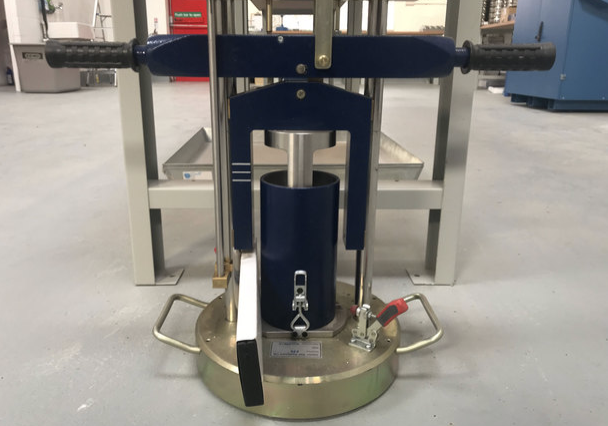
Ask us about your project →It measures the compactive effort a soil needs to reach near-full compaction, which in practice tells you how wet and workable the material is. A 1.5 kg specimen of soil passing a 20 mm sieve is placed in a 100 mm mould and a 7 kg rammer is dropped 250 mm onto it, with penetration recorded as the blows build up. The change in penetration between blow counts is plotted and the MCV read off where that change falls to 5 mm.
It is used to decide whether material can be placed, reworked or set aside, usually within minutes of the sample being taken. Earthworks specifications set acceptability limits for cohesive fill as an MCV range, alongside or instead of a moisture content limit, and the site tests against those limits as material comes out of the cut. Series 600 of the Specification for Highway Works works this way, with project limits given in Appendix 6/1.
MCV is usually carried out to the method in BS 1377-2, which took over the withdrawn Part 4, with BS EN 13286-46 as the European equivalent for unbound and hydraulically bound mixtures. Earthworks contracts normally name the method and the acceptability limits in the specification, and a rapid assessment procedure may be permitted where the full determination is not needed. We work to the method your specification names rather than a house version of it.
It is a relationship between MCV and moisture content, established by testing the same soil at a series of moisture contents. Once that relationship exists for a material, an MCV measured on site can be read across to a moisture content, so acceptability limits expressed either way can be checked with one quick test. It is required where the specification asks for it and has to be established separately for each distinct soil type.
There is no universal figure. The limits are set in the earthworks specification for each class of material. A low MCV means the soil is wet and will not carry plant or compact properly; a high MCV means it is dry and stiff, which can make it hard to compact to the required density. What is acceptable depends on the soil, the fill class and what the material is being used for, so send us the specification and we will confirm what applies.
MCV measures how a soil behaves under compaction, whereas moisture content and plasticity describe what it is. A moisture content needs oven drying and a result the following day, and liquid and plastic limits are laboratory classification tests used to set the acceptability ratio in the first place. MCV gives a number on site in minutes, which is why it is the one used for daily control rather than for classifying material.
Each specimen takes a matter of minutes once the sample has been prepared, so results are available while the plant is still at the face. That is the point of the test: it is a control tool for keeping muck shifting, not a laboratory exercise. Where a full moisture condition calibration is needed, that involves several specimens at different moisture contents and takes longer.
Each specimen uses 1.5 kg of soil passing a 20 mm sieve, and specifications commonly ask for at least two specimens from each sample with the values averaged, so allow a bulk sample of several kilograms. It has to be tested promptly and kept sealed until it is, because the whole result depends on the moisture condition at the moment of sampling. A sample left open in a wagon overnight is no longer representative.
It is designed for cohesive soils, which is where acceptability is governed by moisture condition. Only material passing a 20 mm sieve goes into the mould, so stony soils have to be screened and a very stony fill may not give a representative result at all. Free-draining granular fills, very soft slurried material and some silts are better assessed by other means.
Enough to change a decision, and that is a feature of the test rather than a fault with it. MCV records the condition of the material as it is at that moment, so a cut that was acceptable before a night of rain may not be the next morning, and a stockpile can dry back into range over a hot week. Re-testing after a change in weather is normal practice on an earthworks job.
Ask us to confirm for the method your specification names, because accreditation is granted test by test. Hixtra holds UKAS accreditation to ISO/IEC 17025 for the tests listed in its schedule of accreditation, number 8996. Accreditation is specific to the listed methods and scope. It applies to site testing and laboratory testing separately, so it is worth checking both if your programme uses each.
Cost depends on the number of tests, whether they are one-off visits or an engineer on site through the earthworks and whether a moisture condition calibration is needed for each soil type. Travel, standby time while material is being won and any out-of-hours working also count. Send the site postcode, the earthworks specification, the soil types, the expected number of tests per day and your preferred dates.
In our customers’ words
Independent feedback from the people we work with.
“Punctual, friendly and professional.”Read the full review ↗
“Perfect service and explained everything step by step.”Read the full review ↗
“Excellent service! Incredibly professional. Thankyou”Read the full review ↗
Customers come back to Hixtra
Read independent feedback from customers who have used our testing services.
4.8 / 5 on Trustpilot
“Punctual, friendly and professional.”
Lee Chippington · September 2026
Read this customer’s review ↗Same-day and next-day testing dates available. Tell us what you need and where, or call to check availability.