Understand your material
Measure California Bearing Ratio on prepared laboratory specimens in the specified condition.
Soils & geotechnical laboratory testing
Measure California Bearing Ratio on prepared laboratory specimens in the specified condition.
Same-day & next-day testing dates available. Call to check availability for your location and test requirements.
Practical testing. Experienced people. A service built around your project.
Quality, safety & professional standards
UKAS accreditation applies to the tests listed in our accredited schedule.
View our credentials ↗



Experienced people
Technical knowledge, with practical advice.
National coverage
Testing support wherever your project takes you.
A responsive service
Clear arrangements, from enquiry to reporting.
The right testing for your project
Practical advice, experienced testing staff and clear reporting. Measure California Bearing Ratio on prepared laboratory specimens in the specified condition.
Speak to the team ↗Where this service helps
The right test helps answer a specific project question. We’ll agree the method and requirements with you before the work begins.
Measure California Bearing Ratio on prepared laboratory specimens in the specified condition.
Agree the test method, sample condition and acceptance criteria before the work begins.
Use clear test records to support your project’s material and engineering assessment.
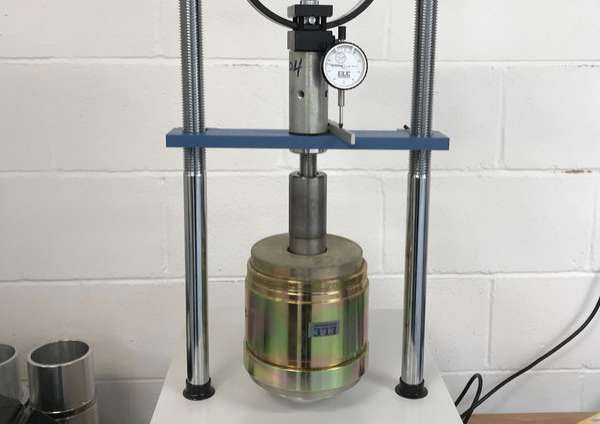
A controlled plunger penetration measures the specimen resistance. Preparation, compaction and moisture condition influence the result. Soaked testing can be arranged where the specification requires assessment after water exposure; it is distinct from a plate-derived CBR result.

A closer look
A controlled plunger penetration measures the specimen resistance. Preparation, compaction and moisture condition influence the result. Soaked testing can be arranged where the specification requires assessment after water exposure; it is distinct from a plate-derived CBR result.
UKAS accreditation applies to the particular methods listed in Hixtra’s current schedule, rather than every service. Ask us to confirm the accreditation status of the testing you require.
Hixtra in action
Working with Hixtra
From your first enquiry to your report, you’ll have practical advice on what to book, how to prepare and what happens next.
Share the site location, materials and testing specification. If you are unsure which test you need, we can help.
We agree the scope, access or sample requirements, availability and reporting arrangements before work starts.
Your results are reported for the agreed testing. Our team is on hand if you need to discuss the report.
Testing support across England & Wales
From individual site visits to ongoing testing programmes, we support construction, civil engineering and geotechnical projects across England and Wales.
Check availability for your site ↗Your questions
Practical answers on what this test is for, how to prepare and what you get back.
Ask us about your project →A specimen is prepared in a 152 mm diameter mould at an agreed density and moisture condition, then a plunger of about 50 mm diameter is driven into it at a nominal one millimetre per minute while force and penetration are recorded. The force reached at 2.5 mm and at 5 mm penetration is compared with the force a standard crushed stone needs at the same penetration, and the higher of the two percentages is reported as the CBR.
Part 4 has been withdrawn, and the compaction related tests including CBR now sit in the 2022 revision of BS 1377-2, so a schedule naming either is asking for the same test. The reference loads that define the ratio are unchanged: 13.2 kN at 2.5 mm penetration and 20 kN at 5 mm. Your specification still sets the compaction condition, the surcharge, whether the specimen is soaked and which value is reported.
Around 6 kg of disturbed material makes one remoulded specimen, and 15 kg or more if a compaction curve has to be established first or several specimens are wanted. Send it sealed and at its natural moisture content rather than dried out, with the sample reference and depth on the container. The test applies to material passing a 20 mm sieve and is not applicable where more than about a quarter of the sample is retained on it.
By the specification, and where that is silent, by what the result is being used for. Common bases are the maximum dry density and optimum moisture content from a compaction test, a stated percentage of that maximum dry density, or the material at its natural moisture content as received. The rammer matters too, since light and heavy compaction give different results on the same soil. Several specimens can be prepared across a moisture range where the design needs it.
Yes, where the sample has been taken in a CBR mould or a tube that can be trimmed into one, the specimen can be tested as received rather than remoulded. That gives a value for the material in the condition it was actually in, which is useful for an existing formation but says nothing about how it will perform once excavated, placed and recompacted. Most design work uses remoulded specimens for exactly that reason.
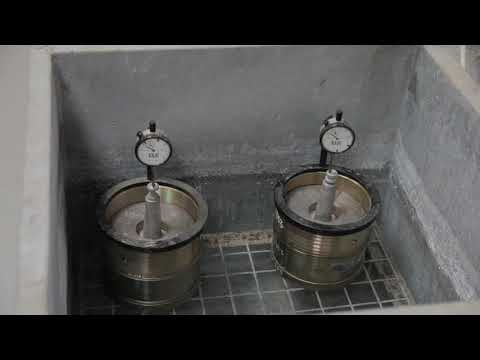
It stands in a tank of water for four days with the annular surcharge discs in place and swell measured by dial gauge, then is drained briefly and penetrated with the same surcharge still on top. The discs represent the weight of construction that will sit above the layer, roughly 70 mm of construction for each 2 kg disc. The swell reading is reported alongside the CBR value.
Both ends of the specimen can be penetrated, giving two results from one mould, because the mould is inverted after the first end has been tested. The two differ because compaction in a mould is never perfectly uniform, so density varies between the top and the bottom of the specimen. Which value is used is a specification matter, with some taking the lower as the conservative figure and others averaging them, so both are shown.
Because the two measure different things. A laboratory CBR is measured on a specimen remoulded to a chosen density and moisture condition, so it reports what the material can do in that defined state, while an in-situ CBR measures the ground exactly as it was on the day, compaction, moisture and all. A soaked laboratory value is usually the lower of the two and a well prepared dry formation can read higher. Neither result is wrong.
An unsoaked test on material that arrives at the right moisture content can be prepared and tested quickly. A soaked test adds at least the four day soak on top of that, and establishing a compaction curve or conditioning the material to a target moisture content first adds more again. Soaking is only carried out where the specification calls for it. We confirm the expected timing before the work is booked.
The CBR percentage at 2.5 mm and 5 mm penetration for each end tested, the load and penetration data behind it, and the condition the specimen was prepared and tested in: dry density, moisture content, compaction method and the surcharge used. Where the specimen was soaked, the soaking period and the swell measured are stated. The sample reference, the method, the accreditation status and any deviation from the specification are also shown.
Hixtra holds UKAS accreditation to ISO/IEC 17025 for the tests listed in its schedule of accreditation, number 8996. Accreditation is specific to the listed methods and scope, so the soaked and unsoaked versions and the different preparation methods are worth checking individually rather than assuming CBR appears as a single line. Ask us to confirm what is in scope, and the report will state the status of each result.
Mainly the number of specimens and how much preparation each one needs. A single unsoaked test on material that arrives ready to use is the simplest case, while establishing a compaction curve, conditioning to a target moisture content, soaking or preparing several specimens across a moisture range all add work. Collection from site adds travel. Send the specification, the number of samples and your required dates and we'll put a price together.
In our customers’ words
Independent feedback from the people we work with.
“Punctual, friendly and professional.”Read the full review ↗
“Perfect service and explained everything step by step.”Read the full review ↗
“Excellent service! Incredibly professional. Thankyou”Read the full review ↗
Customers come back to Hixtra
Read independent feedback from customers who have used our testing services.
4.8 / 5 on Trustpilot
“Punctual, friendly and professional.”
Lee Chippington · September 2026
Read this customer’s review ↗Same-day and next-day testing dates available. Tell us what you need and where, or call to check availability.