Hixtra · concrete cube testing in Manchester

Concrete cube testing in Manchester.

Concrete cube compressive strength testing for Manchester sites. Cubes made by your team or your readymix supplier are sent to our laboratory, cured under controlled conditions and crushed at the ages your specification sets, with every result traceable to its pour.

Talk to Hixtra →0161 871 7372

Cube testing is scheduled against your casting dates. Call to arrange courier delivery or collection from Manchester.

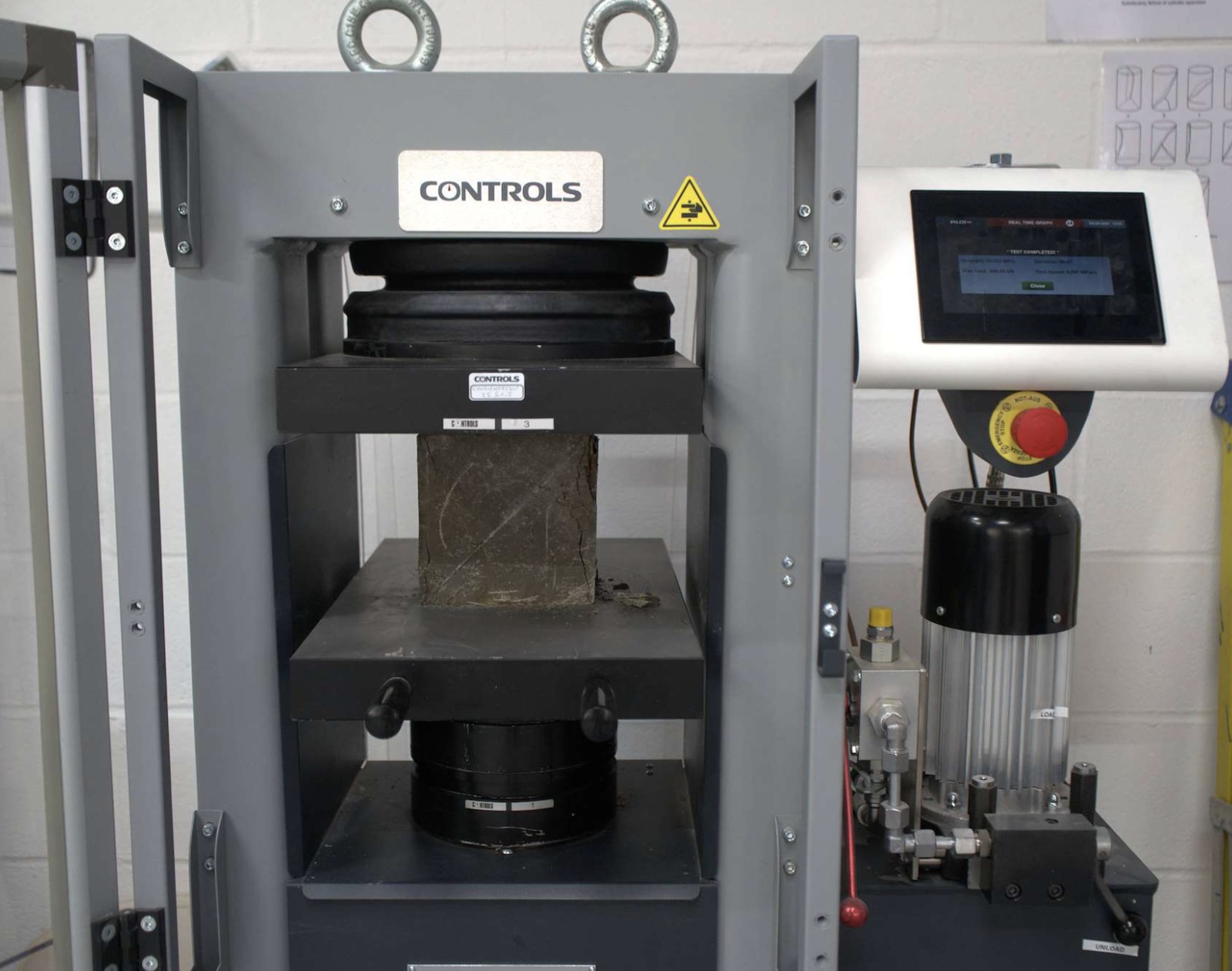
Concrete cube in a compression testing machine

Concrete specimens tested against an agreed method and reporting scope.

Quality, safety & professional standards

Expertise you can check.

UKAS accreditation applies to the tests listed in our accredited schedule. Ask us for the current scope before you book.

Understand our accreditation →
UKAS testing · 8996
CHAS accredited contractor
SSIP scheme assessed
AGS member

Traceable results

Every cube is booked in by reference on arrival, so a result always traces back to the right pour and level.

Cured under control

A controlled curing tank takes the Manchester weather out of the result.

Reported on the day

Results are reported as soon as each cube is crushed, at the ages your specification sets.

Concrete cube testing in Manchester

Cube testing for a city that keeps building upwards.

Manchester and Salford have been pouring tall concrete frames for years, and the logistics floors around the M60, M62 and M6 add a great deal of slab concrete to that. On a frame going up a floor at a time, cube results arrive every week, and they only help if each one can be tied to the right pour and trusted.

01 / CUBES

Cube compressive strength

We carry out concrete cube strength testing at 7 and 28 days, or at the ages your specification sets, including early-age tests where striking or stressing depends on them. Cubes are tested against their casting dates and reported the same day.

02 / CORES

Cores when cubes are not enough

Concrete core testing establishes the strength the concrete has reached in the structure itself, where cube results are missing, low or in dispute. We cut cores on site in Manchester and test them at the laboratory.

03 / CURING & DENSITY

Curing and density

Our curing service keeps cubes in water at a controlled temperature until the day of test, which matters in a city where a cube left outside spends its first week cold and wet. Hardened concrete density testing can be added on the same cubes.

Getting cubes from Manchester to the laboratory.

Manchester is well outside the distance at which our technicians attend pours, so cubes are made by your team or your supplier, sampled to BS EN 12350-1 and made to BS EN 12390-2. Keep them in their moulds, covered, level and protected from frost, rain and vibration for at least 16 hours and no more than 3 days. Then demould, mark each with a unique reference, keep them wet and send them. Most Manchester clients use a courier, with cubes wrapped damp and packed so they cannot knock together. We can also collect while we are in the North West for site testing.

Concrete cube being weighed in a water tank for density testing
Specimens tested under controlled laboratory conditions.Hixtra project photography.

Questions people ask

Your questions, answered.

Practical answers for planning and booking concrete cube testing in Manchester.

Ask us about your project →
Can you attend our Manchester pour to make the cubes?

No. Fresh concrete testing, meaning slump, flow and cube making at the pour, is only available within about an hour’s drive of our laboratory in Milton Keynes, and Manchester, Salford, Stockport and Bolton are all well outside that. Your readymix supplier or your own trained staff will need to make the cubes. We cure and test them.

How do cubes get from Manchester to your laboratory?

Usually by courier. Wrap each cube in damp hessian or cloth and polythene, pack them in a rigid box so they cannot knock together, and send them so they arrive before the first test age. If we are in the North West for plate bearing or CBR work, we can collect at the same time if you tell us when you book. You are also welcome to deliver them.

We pour a floor a week. Can you handle a rolling programme?

Yes. Give us the pour programme and the required ages, and each set of cubes is booked in by reference when it arrives and scheduled against its casting date. Results go to whoever you name as soon as each cube is crushed, so a 7-day result for level 12 is not waiting on anything else. A consistent referencing system on your side, by level and pour, is what makes a rolling programme work.

Can you test cubes at early ages for striking formwork?

Yes, provided the cubes can reach us in time. Early-age tests at 1, 2 or 3 days are sometimes specified to support striking or post-tensioning. From Manchester the courier leg has to be allowed for, so talk to us about timing before the pour. Bear in mind that a cube cured in a tank does not match the temperature history of the slab, so your engineer may want a different approach for very early ages.

How is cube compressive strength measured?

The cube is loaded to failure in a calibrated compression machine, and the strength is the maximum load divided by the cross-sectional area, in newtons per square millimetre. Testing is usually specified to BS EN 12390-3. The report gives the cube reference, the age at test, dimensions, failure load, strength and whether the failure pattern was satisfactory.

Does Manchester’s weather affect cube results?

It can if the cubes are left out in it. In the first day a fresh cube is sensitive to temperature, and a cold, wet night on an exposed slab edge slows strength gain and can lower the result. Keep cubes in their moulds somewhere sheltered at around 20 °C, covered against drying and rain, for 16 hours to 3 days. After that they should be in water in a controlled tank, which is where ours go.

What happens if a cube result is low?

Look at the cube first. Identification, age at test, curing history, dimensions and failure pattern can all produce a low figure that says nothing about the structure. If the result stands, your engineer decides what follows, commonly a spare cube tested at a later age or cores cut from the element. We cut and test cores in Manchester, so the investigation can stay with the same laboratory.

Is cube strength the same as the strength in the structure?

No. A cube is compacted and cured under standard conditions and shows what the concrete as supplied can achieve. Concrete in a column or slab is placed and cured in place and is normally somewhat weaker. Cube results judge the conformity of the supply. In-place strength is assessed from cores.

How many cubes should we make from each pour?

Your specification sets the sampling rate, usually by reference to BS 8500 and BS EN 206, depending on the volume and importance of the pour. A set from each sample covering 7 and 28 days, plus a spare, is common. Make all the cubes in a set from the same sample and tell us which are spares to hold.

Should we use 100 mm or 150 mm cubes?

100 mm cubes suit most structural mixes with 20 mm aggregate, and they are lighter and cheaper to courier. 150 mm cubes are needed where the aggregate is larger, because BS EN 12390-1 ties specimen size to maximum aggregate size. Keep to one size across the job and check whether your contract names one.

Are your cube results UKAS accredited?

Hixtra holds UKAS accreditation to ISO/IEC 17025 under schedule number 8996. Accreditation is granted method by method, not to the company as a whole. Most of our soil and aggregate tests are on the schedule, and some concrete tests are still going through the accreditation process. If your specification or your client’s engineer requires accredited cube results, tell us when you enquire and we will confirm whether that method is on the current schedule before you book.

What should we send with the cubes?

A unique reference marked on every cube and a schedule that matches it: site, level and element poured, supplier and mix reference, casting date and time, testing ages and who receives the results. Add slump or flow if it was measured. On a multi-storey frame, the level and pour reference is the piece of information most often missing.

Do you have a laboratory in Manchester?

No. Hixtra has one laboratory, in Milton Keynes, and every cube is cured and crushed there. The 0161 number rings through to the same team as our other numbers. We have no depot or staff in the North West, which is why cube testing for Manchester works by courier or by collection during a site visit.

In our customers’ words

A reputation built
on the work we do.

Trustpilot 4.8 / 5 ↑

Independent feedback from the people we work with.

★★★★★

Lee ChippingtonTrustpilot · September 2026

Read the full review →
★★★★★

terry heatherTrustpilot · August 2026

Read the full review →
What do you need testing? Select all that apply.

We’ll use these details to respond to your enquiry. For urgent enquiries, call 01908 505833. You can also email enquiries@hixtra.co.uk.

Read our privacy policy. Sending an enquiry does not subscribe you to marketing.

Thank you! Your submission has been received!
Oops! Something went wrong while submitting the form.