Cube compressive strength
We provide concrete cube strength testing at the ages your specification sets, usually 7 and 28 days. Cubes from Nottingham sites are booked in by reference when they arrive and tested against their casting dates.
Hixtra · concrete cube testing in Nottingham
Concrete cube compressive strength testing for Nottingham sites. Cubes made by your team or your supplier come down the M1 to our laboratory, where they are cured under controlled conditions and crushed at the ages your specification sets.
Talk to Hixtra →0115 786 5656Cube testing is scheduled against your casting dates. Call to arrange delivery or collection from Nottingham.
Concrete specimens tested against an agreed method and reporting scope.
Quality, safety & professional standards
UKAS accreditation applies to the tests listed in our accredited schedule. Ask us for the current scope before you book.
Understand our accreditation →



Straight down the M1
The laboratory is about an hour and a half from Nottingham, so delivery, courier and collection are all practical.
Cured under control
Cubes are kept in a controlled curing tank from arrival until the day they are crushed.
Reported on the day
Each result is reported as soon as the cube is tested, and traced to its pour by reference.
Concrete cube testing in Nottingham
Student accommodation and residential frames in the city, warehouse floors along the M1 and A453, and the foundations under every housing site from Clifton to Hucknall all depend on concrete that has to be shown to meet its strength class. That proof is the cube result, and it is only as good as the care taken between the truck and the compression machine.
We provide concrete cube strength testing at the ages your specification sets, usually 7 and 28 days. Cubes from Nottingham sites are booked in by reference when they arrive and tested against their casting dates.
Concrete core testing gives the in-place strength of a slab, wall or base where cube results are missing, low or disputed, or where an existing floor is being assessed for a new use. We cut cores on site around Nottingham.
Our curing service keeps cubes in water at a controlled temperature until they are tested. Hardened concrete density testing can be run on the same cubes as a check on compaction and consistency between loads.
Nottingham is outside the distance at which our technicians attend pours, so cubes are made by your team or your supplier. Sample to BS EN 12350-1, make the cubes to BS EN 12390-2, and leave them in their moulds on a level surface, covered and out of sun, wind and frost, for at least 16 hours and no more than 3 days. Demould, mark each cube with a unique reference, keep them wet and get them to us: deliver them down the M1, send a courier, or ask us to collect while we are in the East Midlands for site testing.

Questions people ask
Practical answers for planning and booking concrete cube testing in Nottingham.
Ask us about your project →No. Slump, flow and cube making at the pour are only offered within about an hour’s drive of our laboratory in Milton Keynes. Nottingham, Derby, Mansfield and Newark are outside that distance. Sites at the southern end of the area, towards Leicester and Market Harborough, are on the margin, so send the postcode and we will confirm. Otherwise your team or your supplier makes the cubes and we test them.
Deliver them to Milton Keynes, about an hour and a half down the M1, send them by courier, or have us collect them during an East Midlands site visit if you tell us when you book. Keep the cubes damp, wrapped and packed so they cannot knock together, and make sure they arrive before the first test age.
Yes, for buried concrete. The Mercia Mudstone south and east of the city, towards Gotham, East Leake and Newark, contains gypsum, and sulfate in the ground attacks concrete that has not been designed for it. Foundations are given a sulfate class from the ground investigation and the mix is designed to suit. A cube test confirms strength, not sulfate resistance, so check the delivery ticket against the specified mix. We test soil samples for sulfate in the laboratory.
The ages your specification sets, usually 7 and 28 days, with conformity normally judged at 28 days. Early-age or 56-day tests can be added where the specification calls for them. Give us the casting date and the ages, and each cube is scheduled and tested on the right day.
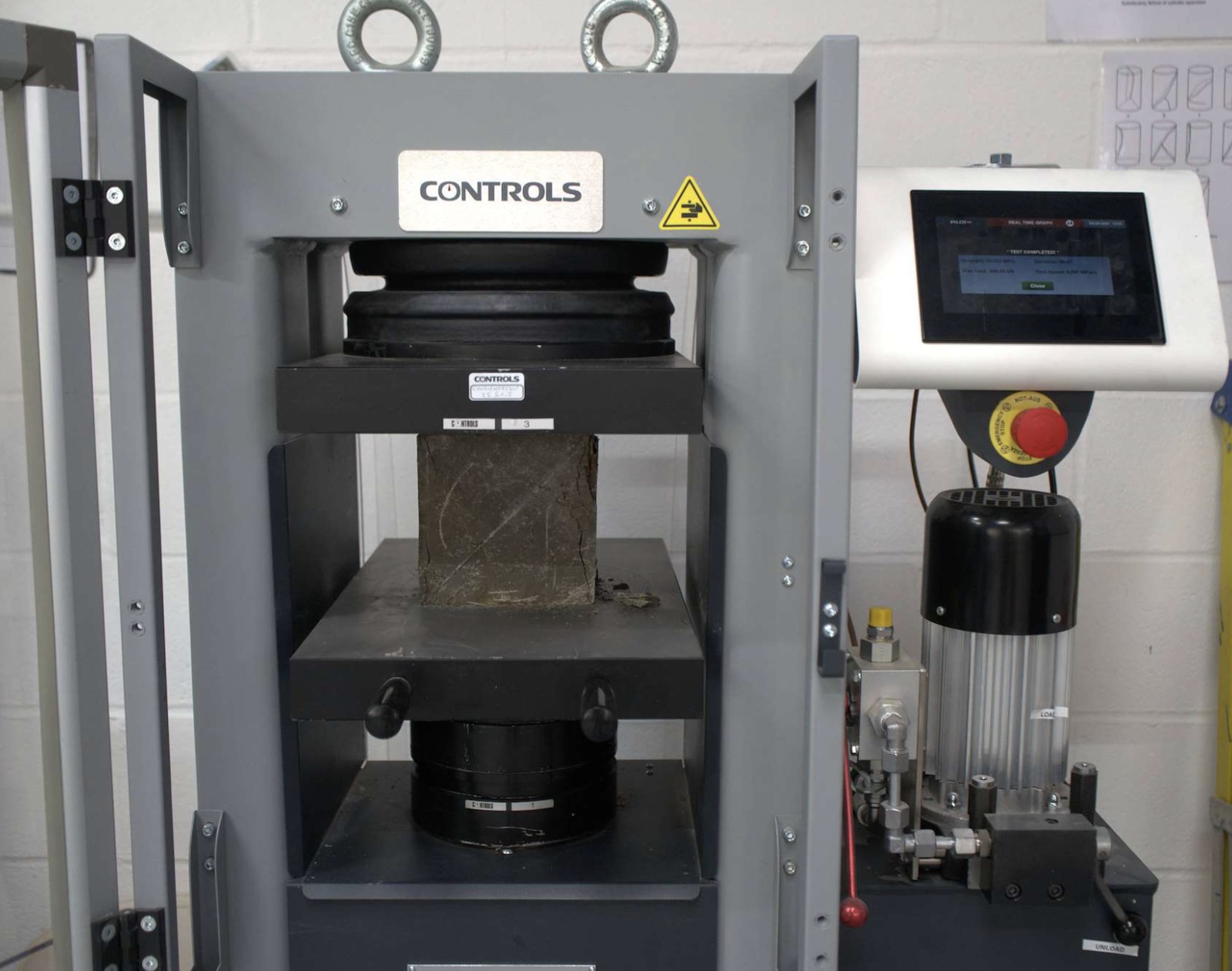
The cube is loaded to failure in a calibrated compression machine, and the strength is the maximum load divided by the cross-sectional area, reported in newtons per square millimetre. Testing is usually specified to BS EN 12390-3. The report gives the reference, age at test, dimensions, failure load, strength and the failure pattern.
Check the specimen record first. Identification, age at test, curing history, dimensions and failure pattern can all explain a low result that has nothing to do with the structure. If the result stands, the next move is your engineer’s, and usually means a spare cube at a later age or cores cut from the element. We can do both.
Your specification sets the sampling rate, usually by reference to BS 8500 and BS EN 206, and on a large floor pour it is normally tied to the volume placed. A set from each sample covering 7 and 28 days, plus a spare, is common. Some floor specifications also call for flexural strength beams, which is a different test, so check what the designer has asked for.
No. A cube is compacted and cured under standard conditions, so it shows what the concrete as supplied can achieve. The slab is placed, compacted and cured in place and is normally somewhat weaker. Cube results judge the conformity of the supply. Where the in-place strength is the question, it is assessed from cores.
100 mm cubes suit most structural concrete with 20 mm aggregate. 150 mm cubes are needed where the aggregate is larger, because BS EN 12390-1 relates specimen size to maximum aggregate size. Use one size across a job so results are compared like with like.
Send them and tell us. We record the condition they arrive in and report the conditioning history with the result, stating any deviation from the standard method. Standard curing is in water at 20 ± 2 °C after demoulding. A cube that has been frozen or dried out can give a result that does not represent the concrete, and your engineer should read it with that in mind.
Hixtra holds UKAS accreditation to ISO/IEC 17025 under schedule number 8996. Accreditation is granted method by method, not to the company as a whole. Most of our soil and aggregate tests are on the schedule, and some concrete tests are still going through the accreditation process. If your specification or your client’s engineer requires accredited cube results, tell us when you enquire and we will confirm whether that method is on the current schedule before you book.
A unique reference on each cube and a matching schedule: site, element poured, supplier and mix reference, casting date and time, testing ages and who receives the results. Add the slump or flow if it was measured. Clear references avoid delays and mean every result can be traced to the pour it came from.
No. Hixtra has one laboratory, in Milton Keynes, and every cube is cured and crushed there. The 0115 number rings through to the same team as our other numbers. We are in the East Midlands regularly for ground testing, so collection can often be tied in with a site visit.
Keep reading
In our customers’ words
Independent feedback from the people we work with.
“Punctual, friendly and professional.”Read the full review →
“Perfect service and explained everything step by step.”Read the full review →
“Excellent service! Incredibly professional. Thankyou”Read the full review →