Understand your material
Determine hardened concrete density for comparison, quality control and investigation.
Concrete testing & coring
Determine hardened concrete density for comparison, quality control and investigation.
Same-day & next-day testing dates available. Call to check availability for your location and test requirements.
Practical testing. Experienced people. A service built around your project.
Quality, safety & professional standards
UKAS accreditation applies to the tests listed in our accredited schedule.
View our credentials ↗



Experienced people
Technical knowledge, with practical advice.
National coverage
Testing support wherever your project takes you.
A responsive service
Clear arrangements, from enquiry to reporting.
The right testing for your project
Practical advice, experienced testing staff and clear reporting. Determine hardened concrete density for comparison, quality control and investigation.
Speak to the team ↗Where this service helps
The right test helps answer a specific project question. We’ll agree the method and requirements with you before the work begins.
Determine hardened concrete density for comparison, quality control and investigation.
Agree the test method, sample condition and acceptance criteria before the work begins.
Use clear test records to support your project’s material and engineering assessment.
Density measurements provide information about the tested specimen and can help compare samples or batches. Sample preparation and conditioning should follow the agreed method. Discuss whether density is required as a standalone measurement or alongside core or cube strength testing.

A closer look
Density measurements provide information about the tested specimen and can help compare samples or batches. Sample preparation and conditioning should follow the agreed method. Discuss whether density is required as a standalone measurement or alongside core or cube strength testing.
UKAS accreditation applies to the particular methods listed in Hixtra’s current schedule, rather than every service. Ask us to confirm the accreditation status of the testing you require.
Hixtra in action
Working with Hixtra
From your first enquiry to your report, you’ll have practical advice on what to book, how to prepare and what happens next.
Share the site location, materials and testing specification. If you are unsure which test you need, we can help.
We agree the scope, access or sample requirements, availability and reporting arrangements before work starts.
Your results are reported for the agreed testing. Our team is on hand if you need to discuss the report.
Testing support across England & Wales
From individual site visits to ongoing testing programmes, we support construction, civil engineering and geotechnical projects across England and Wales.
Check availability for your site ↗Your questions
Practical answers on what this test is for, how to prepare and what you get back.
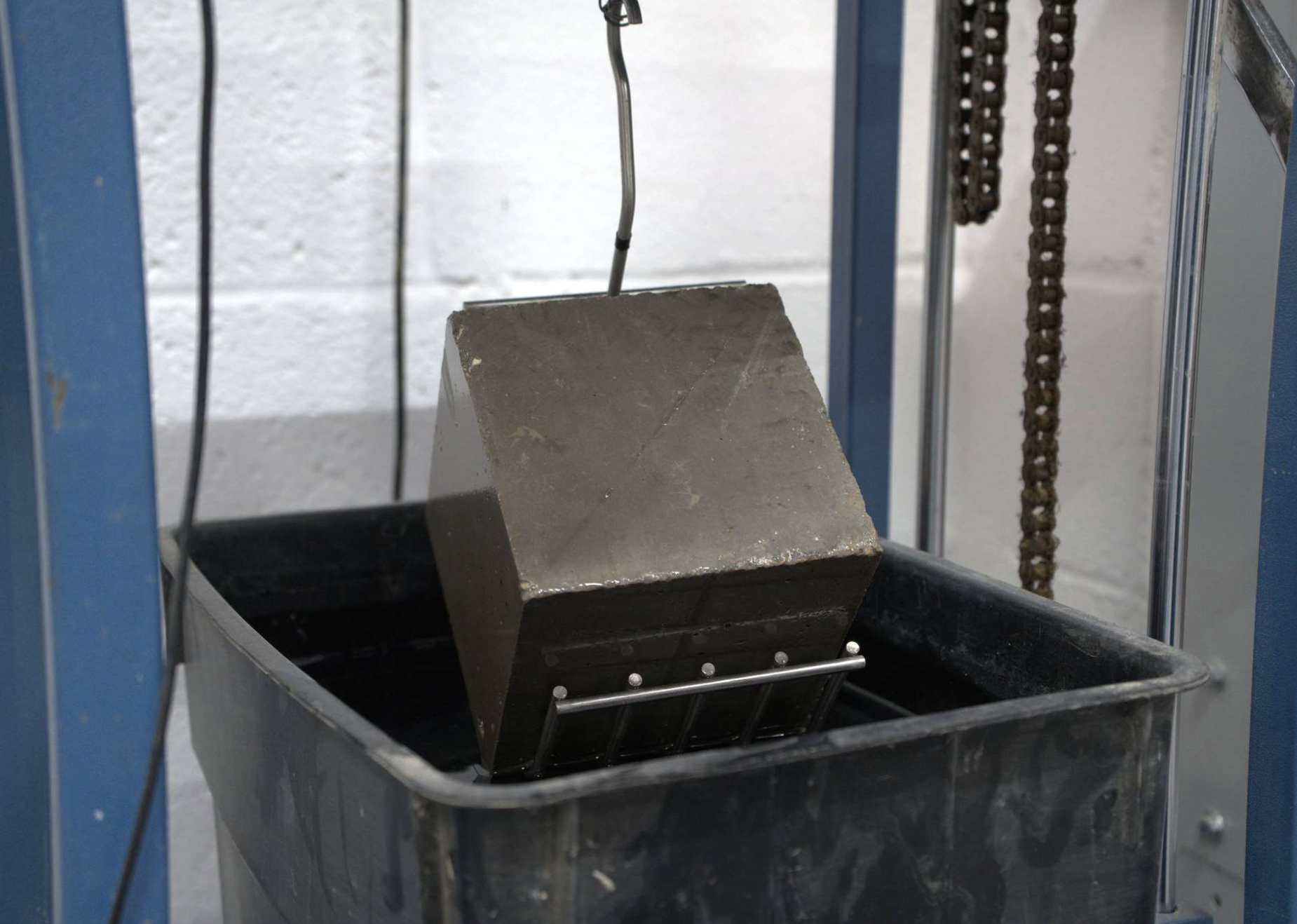
Ask us about your project →Density is the mass of the specimen divided by its volume, so the test is a careful determination of both. The specimen is weighed, and its volume is found either by water displacement or by measuring its dimensions. The test does not damage the specimen and is normally carried out on the same cube or core immediately before a compression test, so a strength result and a density result can come from one specimen.
Hardened density is usually determined to BS EN 12390-7, which covers the methods, the condition of the specimen and how the result is reported. It gives water displacement as the reference method for volume, with calculation from measured dimensions as an alternative. The result is expressed to the nearest 10 kg/m³. Where your specification names a different method, we work to that instead.
Fresh density is measured on the concrete as delivered, in a container of known volume and usually to BS EN 12350-6, and is used as a yield and compaction check at the point of placing. Hardened density is measured on a cured specimen days or years later and reflects the concrete as it actually set, including any voids left by poor compaction. The two are related but are not the same number, and a specification will normally say which it wants.
BS EN 12390-7 allows density to be determined in any of three conditions: as received, water saturated or oven dried. The condition changes the answer, because water held in the pores adds mass, so a specification quoting a density limit should say which condition it applies to. Oven drying is the one that affects the programme, since the specimen has to be dried to constant mass before it is weighed, and that adds days.
Water displacement is the reference method and the most precise, and it is the sensible choice for cores, trimmed pieces and anything that is not a regular shape. Volume calculated from the actual measured dimensions is a reasonable alternative for a sound cube. Calculating from the designated mould size is the least precise and only works where the moulds themselves are checked. If the figure is going into a conformity decision, use displacement.
Most normal-weight structural concrete comes out somewhere around 2300 to 2500 kg/m³, though the figure moves with the aggregate used. BS EN 206 treats concrete with an oven-dry density above 2000 and up to 2600 kg/m³ as normal weight, below 2000 as lightweight aggregate concrete and above 2600 as heavyweight. A result well outside the expected range for the mix is worth investigating rather than accepting.
It can, when there is something to compare it with. Poorly compacted concrete contains voids, and voids show up as a lower density than a well compacted specimen of the same mix, which makes density a useful check on compaction. On its own a single figure says very little. It is most valuable read alongside the mix design, a companion specimen or a run of results from the same concrete.
Lightweight concrete is normally specified by oven-dry density, so the specimen is dried to constant mass before the determination and the result is compared with the density class in the specification. Getting the condition right is the whole exercise, because an as-received figure on a lightweight concrete will read higher than the oven-dry value it is being judged against. Tell us the density class you are working to when the specimens are booked in.
A cube, a cylinder or a core is the usual specimen, and density can be taken from specimens already coming to us for strength testing. The piece has to be intact, sound and large enough to be representative of the concrete, which in practice means comfortably larger than the biggest aggregate particles in it. An irregular trimmed piece can be tested by water displacement where a regular specimen is not available.
The most common reasons are air voids from incomplete compaction, a difference in the moisture condition at test and an aggregate with a different particle density from the one assumed. Entrained air deliberately added for freeze-thaw durability also lowers the figure, as does a higher water content. A low density alongside a low strength usually points at compaction. A low density with an acceptable strength more often points at the mix or the condition the specimen was tested in.
Hixtra holds UKAS accreditation to ISO/IEC 17025 for the tests listed in its schedule of accreditation, number 8996. Accreditation is specific to the listed methods and scope, and density can be determined in several conditions and by more than one method, so this is a question worth asking precisely. Tell us which method and condition your specification calls for and we will confirm the accreditation status before you book.
Send the number and type of specimens, the condition and method your specification requires, the site postcode and your preferred dates. Say whether density is wanted on its own or alongside cube or core strength testing, since determining both on the same specimen is the efficient route. Cost is driven by the number of specimens, the preparation involved and whether oven drying is needed, which takes longer than testing as received.
In our customers’ words
Independent feedback from the people we work with.
“Punctual, friendly and professional.”Read the full review ↗
“Perfect service and explained everything step by step.”Read the full review ↗
“Excellent service! Incredibly professional. Thankyou”Read the full review ↗
Customers come back to Hixtra
Read independent feedback from customers who have used our testing services.
4.8 / 5 on Trustpilot
“Punctual, friendly and professional.”
Lee Chippington · September 2026
Read this customer’s review ↗Same-day and next-day testing dates available. Tell us what you need and where, or call to check availability.