Cube compressive strength
We carry out concrete cube strength testing at the ages your specification sets, usually 7 and 28 days, on cubes we made at your pour or cubes you bring in. Each one is tracked by reference from mould to report.
Hixtra · concrete cube testing in Milton Keynes
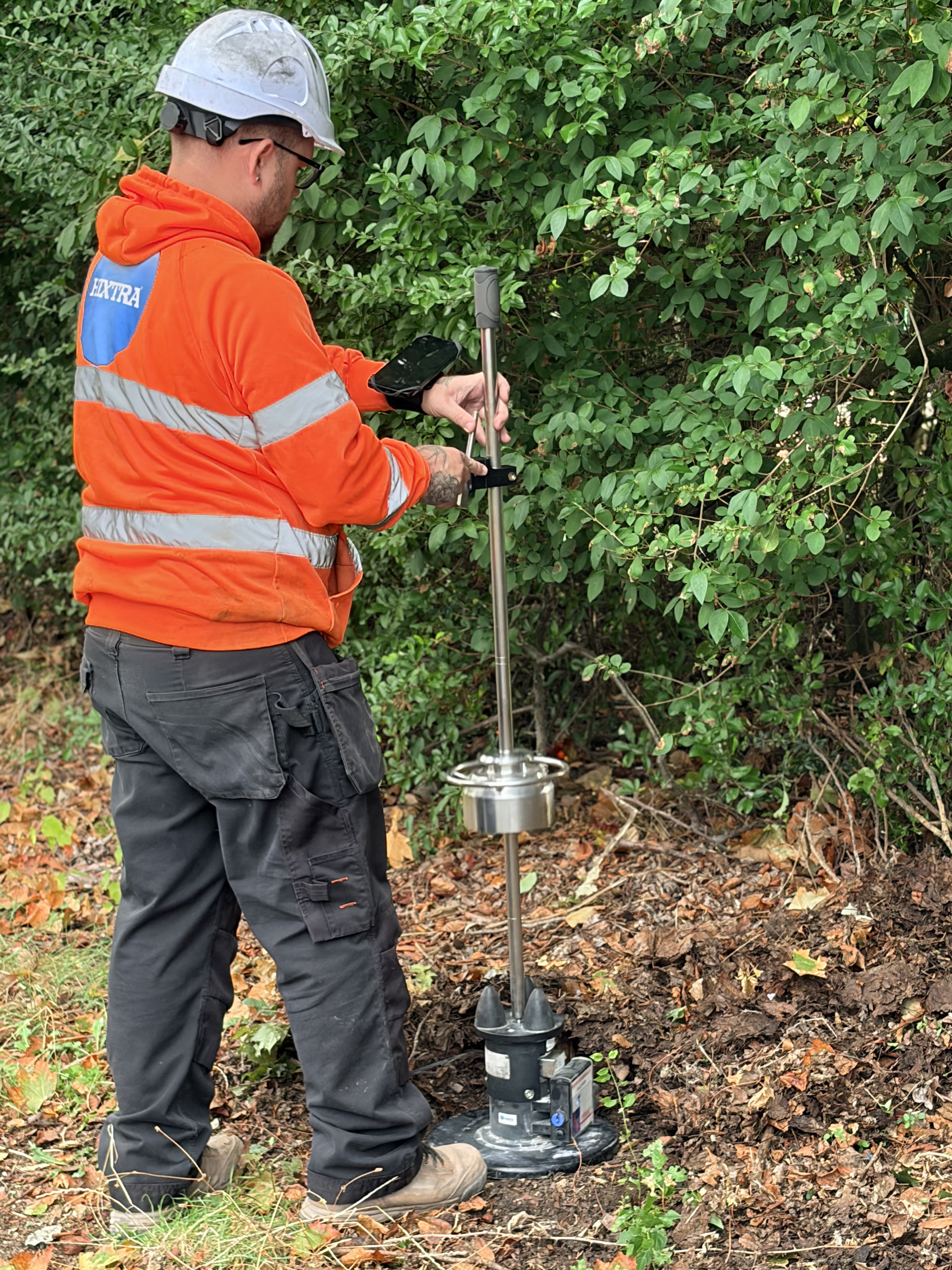
Concrete cube compressive strength testing in Milton Keynes, from the laboratory we run in the city. Our technicians attend your pour, test the slump or flow, make the cubes and have them in a controlled curing tank the same day. Cubes made by your own team can be dropped at the door.
Talk to Hixtra →01908 505833Same-day and next-day dates are often available for pours in and around Milton Keynes. Call to check availability.
Concrete specimens tested against an agreed method and reporting scope.
Quality, safety & professional standards
UKAS accreditation applies to the tests listed in our accredited schedule. Ask us for the current scope before you book.
Understand our accreditation →


We attend the pour
Slump, flow and cube making on your site, by our own technicians, as a matter of course.
In the tank the same day
The laboratory is minutes away, so cubes are in controlled curing within hours, not days.
Reported on the day
Each result is reported as soon as the cube is crushed, at the ages your specification sets.
Concrete cube testing in Milton Keynes
Milton Keynes and the towns around it pour a great deal of concrete: distribution floors, housing foundations, frames and highway structures. This is the one area where we cover every step ourselves, from sampling at the truck to the crushed cube, because every site is inside an hour of the laboratory.
We carry out concrete cube strength testing at the ages your specification sets, usually 7 and 28 days, on cubes we made at your pour or cubes you bring in. Each one is tracked by reference from mould to report.
Concrete core testing gives the in-place strength of a slab, wall or base where cube results are missing, low or disputed. Locally that is a short drive, so cores are often cut and back in the laboratory the same day.
Our curing service keeps cubes in water at a controlled temperature from the day they are demoulded until they are crushed. Hardened concrete density testing can be carried out on the same cubes as a check on compaction.
Tell us the pour date and start time, the supplier and mix reference, how many cubes you need and at what ages, and whether slump or flow is to be taken at the truck or at the point of placement. Our technician samples to BS EN 12350-1, makes the cubes to BS EN 12390-2 and sees them safely through their first day. If a pour has been brought forward, ring. A same-day visit is sometimes possible, depending on what is already booked. Readymix suppliers use this service as well as the contractors receiving the concrete.

Questions people ask
Practical answers for planning and booking concrete cube testing in Milton Keynes.
Ask us about your project →Yes. This is the one area where that is a plain yes. Fresh concrete testing is offered within about an hour’s drive of the laboratory, and Milton Keynes, Bletchley, Newport Pagnell, Bedford, Northampton, Buckingham, Aylesbury and Luton all sit inside that. We attend the pour, test the slump or flow on arrival and make the cubes at the point of placement.
Yes. Cubes made by your own team or your supplier can be dropped at the door during working hours. Ring before you set off so someone is ready to book them in, and mark each cube with a unique reference. Bring them damp, after at least 16 hours and within 3 days of casting, and they go straight into the curing tank.
Because the commonest cause of a disputed cube result is poor early curing, and distance makes that worse. A cube that spends its first days in a cold cabin or the back of a van is not the cube the standard describes. Here, cubes are in a controlled tank at 20 ± 2 °C within hours of demoulding, so the result reflects the concrete and not the journey.
The ages your specification sets. Most structural concrete is tested at 7 and 28 days, with conformity normally judged at 28 days. Because there is no courier leg, early-age tests at 1, 2 or 3 days are practical here where striking or loading depends on them. Tell us the ages when you book.
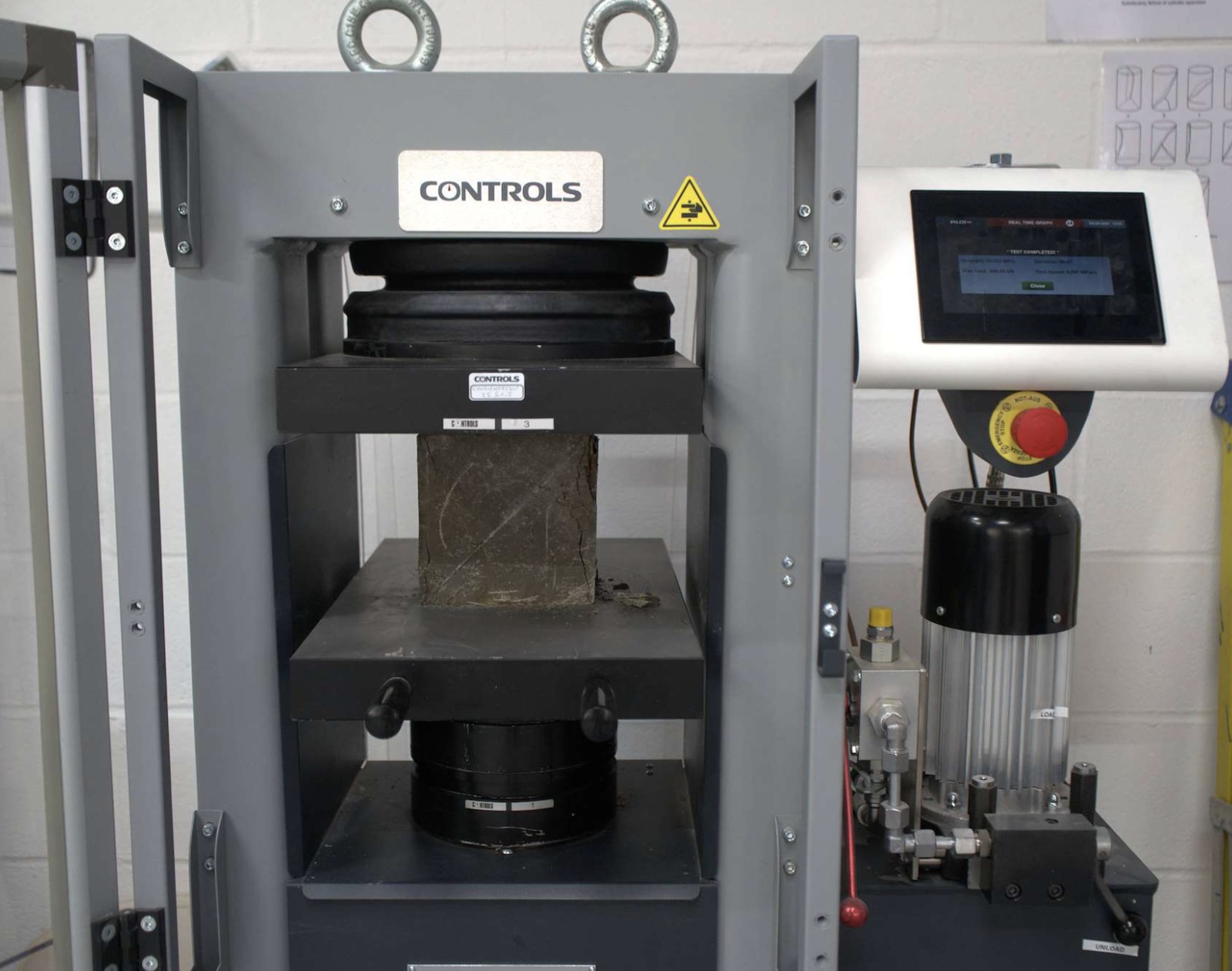
The cube is loaded to failure in a calibrated compression machine, and the strength is the maximum load divided by the cross-sectional area, reported in newtons per square millimetre. Testing is usually specified to BS EN 12390-3. The report gives the reference, age at test, dimensions, failure load, strength and the failure pattern.
Yes. On a pour visit we measure consistence on arrival, by slump or by flow for more fluid mixes, and record it against the delivery ticket before the concrete is placed. A load that is outside the specified consistence can then be dealt with at the truck, which is a great deal cheaper than dealing with it after 28 days.
Your specification sets the sampling rate, usually by reference to BS 8500 and BS EN 206, and on a large floor it is normally tied to the volume placed. A set from each sample covering 7 and 28 days, plus a spare, is common. Some floor specifications also ask for flexural strength beams, which is a different test, so check what the designer wants.
Check the cube first. Identification, age, curing history, dimensions and failure pattern can all explain a low figure. Where we made and cured the cubes ourselves, most of those doubts are already closed. If the result stands, your engineer decides what follows, commonly a spare cube at a later age or cores from the element, which locally we can often cut within a day or two.
It affects the concrete that should be specified. Oxford Clay contains pyrite and sulfates, so foundations and other buried concrete are designed to a sulfate class from the ground investigation. A cube test confirms strength, not sulfate resistance, so the delivery ticket should be checked against the specified mix. We test soil samples for sulfate in the same laboratory.
100 mm cubes suit most structural concrete with 20 mm aggregate. 150 mm cubes are needed where the aggregate is larger, because BS EN 12390-1 relates specimen size to maximum aggregate size. If we are making the cubes, tell us the mix and we bring the right moulds.
Hixtra holds UKAS accreditation to ISO/IEC 17025 under schedule number 8996. Accreditation is granted method by method, not to the company as a whole. Most of our soil and aggregate tests are on the schedule, and some concrete tests are still going through the accreditation process. This matters most here, because this is where our fresh concrete work happens. If your specification requires accredited results, name the tests when you enquire and we will confirm which are on the current schedule before you book.
No. A cube is compacted and cured under standard conditions and shows what the concrete as supplied can achieve. Concrete in the structure is placed and cured in place and is normally somewhat weaker. Cube results judge the conformity of the supply. In-place strength is assessed from cores.
At the Hixtra laboratory in Milton Keynes, which is also our head office. 01908 505833 rings there. Every cube we test from anywhere in England and Wales is cured and crushed in the same place, on the same calibrated machine. Local clients simply have the shortest journey to it.
Keep reading
In our customers’ words
Independent feedback from the people we work with.
“Punctual, friendly and professional.”Read the full review →
“Perfect service and explained everything step by step.”Read the full review →
“Excellent service! Incredibly professional. Thankyou”Read the full review →