November 6, 2026
What does a sulfate soundness test tell you about aggregate?
A specification asks for a sulfate soundness result on untested aggregate. This explains what the MS value shows, how to read it and when another test fits.

Practical testing. Experienced people. A service built around your project.
A Type 1 subbase aggregate is due from a source with no test history. The specification wants a sulfate soundness test result before any of it goes down. What will that number tell you, and is this the test you need?
A sulfate soundness test measures how well an aggregate resists breaking down when salt repeatedly crystallises in its pores. The result is a percentage loss of mass, reported as the MS value, where a lower number is better.
Key takeaways
- The test soaks specimens in saturated magnesium sulfate solution and oven dries them over five cycles. Salt crystals grow in the pores and force particles apart, and it's usually carried out to BS EN 1367-2.
- The result is the percentage loss of mass, the MS value. An MS value of 10 means 10% of the tested fraction was lost over the five cycles.
- Los Angeles abrasion covers mechanical fragmentation in handling and compaction. Use the freeze-thaw test only where the specification accepts it as an alternative.
- On some limestone and dolomitic sources the number can read worse than real performance. Discuss it before rejecting material.
In this guide
- What the sulfate soundness test measures
- How do you read an MS value?
- When you don't need this test, and which test instead
- Frequently asked questions
- What to have ready before you book
What the sulfate soundness test measures
It tells you about weathering breakdown, and says nothing about how the aggregate copes with being knocked about.
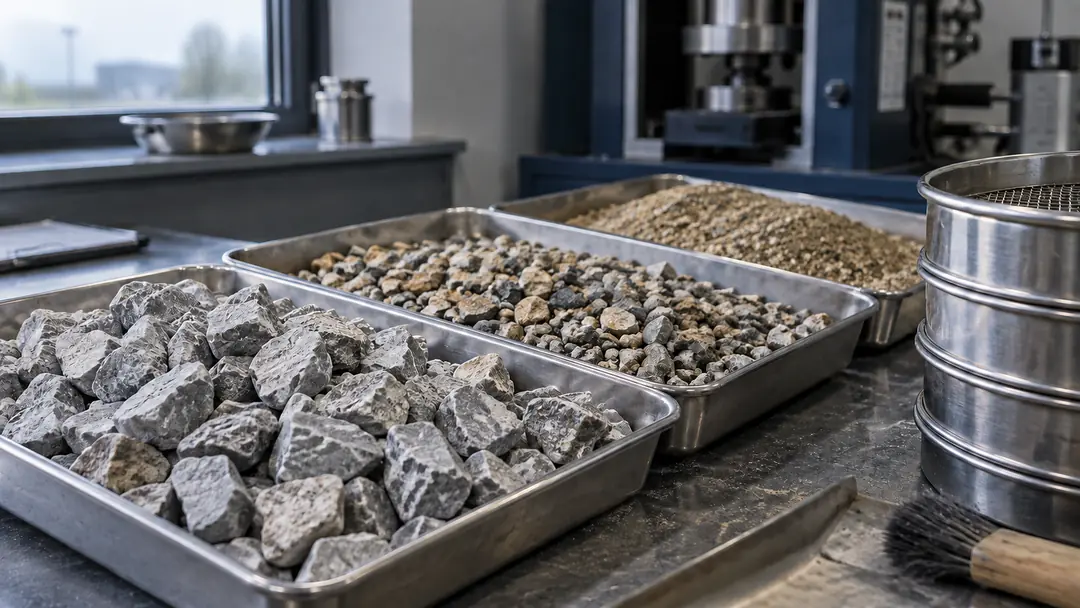
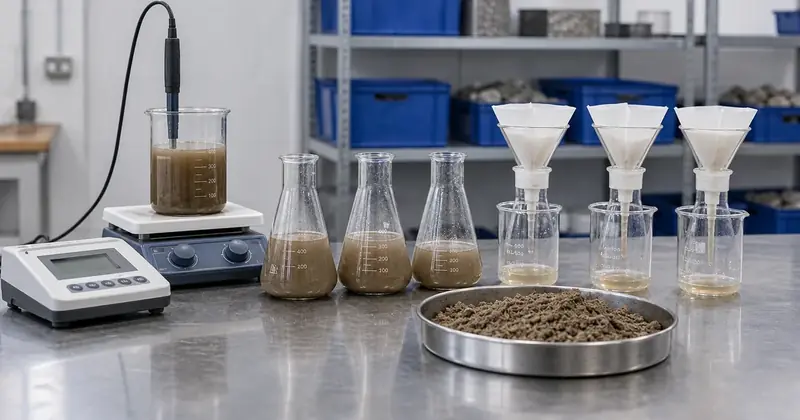
Specimens are soaked in saturated magnesium sulfate solution, then oven dried, and the cycle runs five times. As the salt crystallises inside the pores, it pushes particles apart. A weak aggregate gives way, while a sound one doesn't.
Specimens are prepared from the material passing 14 mm and retained on 10 mm, and breakdown is assessed from the proportion that ends up finer than 10 mm after the cycles. The test is usually carried out to BS EN 1367-2, the magnesium sulfate test within the series covering thermal and weathering properties of aggregates.
You'll see it asked for on recycled and secondary materials, and on sources with no test history, where there's less to fall back on than with an established quarry product.
Don't confuse it with chemical sulfate content testing, which is a separate job covered by chemical testing.
How do you read an MS value?
Take an MS value of 10, which means 10% of the tested fraction was lost over the five cycles.
Some specifications call up a category rather than a method. The category comes from the same family of standards, so read it against the specification line itself. The limit that applies is whatever your specification sets.
What does a loss look like in the ground? In a subbase (see Type 1 subbase testing), an aggregate that breaks down tends to show it as loss of interlock, softening, pumping and settlement rather than sudden failure. The layer slowly stops doing its job.
When you don't need this test, and which test instead
Skip it if the worry is handling and compaction, because Los Angeles abrasion testing is the better fit and soundness won't answer that question. Limestone or a dolomitic source? Talk to us first.
Three tests that get confused
| Test | What it measures | What the result shows | When it comes up |
|---|---|---|---|
| Magnesium sulfate soundness (BS EN 1367-2) | Resistance to weathering, through repeated salt crystallisation in the pores over five cycles | Percentage loss of mass, reported as the MS value (lower is better) | Specifications calling up soundness; recycled and secondary materials; sources with no test history |
| Los Angeles abrasion | Resistance to mechanical fragmentation, essentially how particles cope with being knocked about during handling and compaction | How well the particles resist fragmentation | When the question is handling and compaction |
| Direct freeze-thaw test | The closest equivalent to magnesium sulfate soundness in the same family of standards | A freeze-thaw alternative to the soundness test | Only where the specification accepts it as an alternative |
A specification that names freeze-thaw. The direct freeze-thaw test is the closest equivalent to the magnesium sulfate test, and some specifications accept it as an alternative. Check your specification's wording before assuming yours does.
Limestone or dolomitic sources. The standard notes reservations about some carbonate aggregates and some aggregates with a high proportion of magnesium bearing material. On those, the result can read worse than real performance in the ground. If an MS value is out of line with your experience of the source, discuss it before the material is rejected.
Frequently asked questions
What is a good MS value for aggregate?
There's no general figure. The number that counts comes from your specification or category. The MS value is the percentage loss of mass of the tested fraction over the five cycles, so an MS value of 10 means 10% was lost. Lower is better.
Is the sulfate soundness test the same as the Los Angeles abrasion test?
No. Sulfate soundness measures weathering: how the aggregate holds up when salt crystallises in its pores. Los Angeles abrasion measures mechanical fragmentation, essentially how particles cope with being knocked about during handling and compaction. Neither stands in for the other, so match the test to the question your specification is asking.
Can limestone fail a sulfate soundness test and still perform in the ground?
Yes, on some of them. The standard records reservations about some carbonate aggregates and some aggregates with a high proportion of magnesium bearing material, and on those the result can read worse than real performance in the ground. An unexpected MS value is worth discussing with us before the material is rejected.
How much aggregate do I need to send for a sulfate soundness test?
Enough to yield a good quantity of clean 10 mm to 14 mm particles after sieving, which usually means a bulk sample of several tens of kilograms rather than a single bag. Check the sample size against your source before you send anything.
What to have ready before you book
Send the material and its source, the specification or category you're testing against, the number of samples, the site postcode and your preferred dates.
Check the sample size too, because the bulk sample must hold enough of the size fraction the test uses, which isn't a given for a finely graded material.
UKAS accreditation applies to the particular methods listed in Hixtra’s current schedule, rather than every service. Ask us to confirm the accreditation status of the testing you require.
You can read more about the method on our magnesium sulfate soundness testing page, or see the other tests under aggregate testing.
Call 01908 505833 or your regional number, or send the enquiry form, and we'll confirm availability and the tests you need before anything is booked.
More from Hixtra.
Practical testing guidance and project updates from our team.
All news & projects →
Testing support across England & Wales
Testing arranged around your programme.
Tell us the specification, the number of test positions and your dates. We confirm what is needed and when we can attend before the work is booked.
Check availability for your site →