Understand your material
Assess aggregate resistance to the disruptive effects of repeated salt crystallisation.
Aggregates & subbase testing
Assess aggregate resistance to the disruptive effects of repeated salt crystallisation.
Same-day & next-day testing dates available. Call to check availability for your location and test requirements.
Practical testing. Experienced people. A service built around your project.
Quality, safety & professional standards
UKAS accreditation applies to the tests listed in our accredited schedule.
View our credentials ↗



Experienced people
Technical knowledge, with practical advice.
National coverage
Testing support wherever your project takes you.
A responsive service
Clear arrangements, from enquiry to reporting.
The right testing for your project
Practical advice, experienced testing staff and clear reporting. Assess aggregate resistance to the disruptive effects of repeated salt crystallisation.
Speak to the team ↗Where this service helps
The right test helps answer a specific project question. We’ll agree the method and requirements with you before the work begins.
Assess aggregate resistance to the disruptive effects of repeated salt crystallisation.
Agree the test method, sample condition and acceptance criteria before the work begins.
Use clear test records to support your project’s material and engineering assessment.
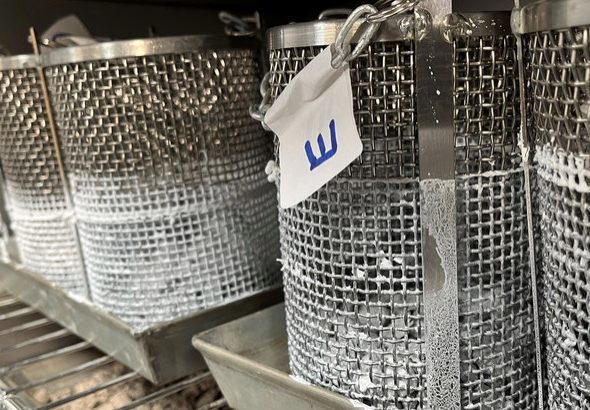
Prepared aggregate specimens undergo cycles of immersion in magnesium sulfate solution and drying. Breakdown is measured after the specified procedure. The result forms part of the wider assessment of material suitability where the project requires soundness testing.

A closer look
Prepared aggregate specimens undergo cycles of immersion in magnesium sulfate solution and drying. Breakdown is measured after the specified procedure. The result forms part of the wider assessment of material suitability where the project requires soundness testing.
UKAS accreditation applies to the particular methods listed in Hixtra’s current schedule, rather than every service. Ask us to confirm the accreditation status of the testing you require.
Hixtra in action
Working with Hixtra
From your first enquiry to your report, you’ll have practical advice on what to book, how to prepare and what happens next.
Share the site location, materials and testing specification. If you are unsure which test you need, we can help.
We agree the scope, access or sample requirements, availability and reporting arrangements before work starts.
Your results are reported for the agreed testing. Our team is on hand if you need to discuss the report.
Testing support across England & Wales
From individual site visits to ongoing testing programmes, we support construction, civil engineering and geotechnical projects across England and Wales.
Check availability for your site ↗Your questions
Practical answers on what this test is for, how to prepare and what you get back.
Ask us about your project →It measures how well an aggregate resists breaking down when salt repeatedly crystallises in its pores. Specimens are soaked in a saturated magnesium sulfate solution and then oven dried, over and over, so that salt crystals grow inside the pore structure and force the particles apart. The proportion of the aggregate that breaks down is the result. It stands as a proxy for how the material will cope with weathering and freeze-thaw in service.
It is usually carried out to BS EN 1367-2, the magnesium sulfate test within the series covering thermal and weathering properties of aggregates. The method uses five cycles of immersion in saturated magnesium sulfate solution followed by oven drying, on specimens prepared from a defined size fraction. Where your specification calls up a category rather than a method, that category comes from the same family of standards.
The 10 mm to 14 mm fraction. Specimens are prepared from the material passing 14 mm and retained on 10 mm, and breakdown is assessed from the proportion that ends up finer than 10 mm after the cycles. That has a practical consequence, because the bulk sample you send has to contain enough of that size band, which is not a given for a finely graded material. The standard does allow other fractions where the material demands it.
As a percentage loss of mass, reported as the MS value, where a lower number is better. A material with an MS value of 10 has lost 10% of the tested fraction over the five cycles. Specifications set a ceiling using categories such as MS18, MS25 and MS35, and Type 1 unbound mixture is commonly required to meet MS35, meaning a loss of no more than 35%.
It means the aggregate is likely to break down where it is repeatedly wetted and dried or frozen and thawed, generating fines from particles that were sound when they were laid. In a subbase that shows up as loss of interlock, softening, pumping and settlement rather than as sudden failure. It matters most in positions that stay damp or sit close to the surface, and much less where the material is buried, dry and confined.
They answer different questions. Los Angeles abrasion measures resistance to mechanical fragmentation, essentially how particles cope with being knocked about during handling and compaction, while magnesium sulfate soundness measures resistance to weathering. The direct freeze-thaw test in the same family of standards is the closest equivalent, and some specifications accept it as an alternative. Type 1 specifications commonly call for the abrasion and soundness results together, because one does not substitute for the other.
Most often when an aggregate is going into a position exposed to wetting and drying or to frost, or when the specification requires a declared durability category. Type 1 unbound mixture is the common case on highway and development work. It is also asked for on recycled and secondary materials and on sources with no test history, where there is less to fall back on than with an established quarry product.
The cycling alone runs to five full cycles of immersion and oven drying, so the test occupies the laboratory for the better part of a week before sample preparation and final sieving are counted. It is slower than grading or abrasion but considerably quicker than frost heave, which is worth knowing when the two are booked together. We confirm the expected reporting date for the agreed scope before the work starts.
Enough to yield a good quantity of clean 10 mm to 14 mm particles after sieving, which usually means a bulk sample of several tens of kilograms rather than a single bag. The coarser and the more widely graded the material, the more you need to send. If the source turns out to be short of that size band we will say so before testing rather than after.
Not entirely. The standard itself notes that the method may not be suitable for all rock types, with reservations recorded about some carbonate aggregates and some aggregates containing a high proportion of magnesium bearing material. On those materials the result can read worse than the aggregate's real performance in the ground. If you are testing a limestone or a dolomitic source and the number looks out of line with experience, it is worth discussing before the material is rejected.
Hixtra holds UKAS accreditation to ISO/IEC 17025 for the tests listed in its schedule of accreditation, number 8996. Accreditation is specific to the listed methods and scope, so it covers particular methods rather than every service we provide. Ask us to confirm whether the soundness testing your specification requires is covered before you book, and we will say clearly if any part of it is not.
The material and its source, the specification or category you are testing against, the number of samples, the site postcode and your preferred dates. Cost is driven by the number of samples, the preparation needed to recover the tested size fraction and whether we are sampling for you or you are delivering material. Tell us what else is in the suite and we will price the programme as a whole.
In our customers’ words
Independent feedback from the people we work with.
“Punctual, friendly and professional.”Read the full review ↗
“Perfect service and explained everything step by step.”Read the full review ↗
“Excellent service! Incredibly professional. Thankyou”Read the full review ↗
Customers come back to Hixtra
Read independent feedback from customers who have used our testing services.
4.8 / 5 on Trustpilot
“Punctual, friendly and professional.”
Lee Chippington · September 2026
Read this customer’s review ↗Same-day and next-day testing dates available. Tell us what you need and where, or call to check availability.