Understand your material
Determine liquid limit, plastic limit and plasticity index for fine-grained soils.
Soils & geotechnical laboratory testing
Determine liquid limit, plastic limit and plasticity index for fine-grained soils.
Same-day & next-day testing dates available. Call to check availability for your location and test requirements.
Practical testing. Experienced people. A service built around your project.
Quality, safety & professional standards
UKAS accreditation applies to the tests listed in our accredited schedule.
View our credentials ↗



Experienced people
Technical knowledge, with practical advice.
National coverage
Testing support wherever your project takes you.
A responsive service
Clear arrangements, from enquiry to reporting.
The right testing for your project
Practical advice, experienced testing staff and clear reporting. Determine liquid limit, plastic limit and plasticity index for fine-grained soils.
Speak to the team ↗Where this service helps
The right test helps answer a specific project question. We’ll agree the method and requirements with you before the work begins.
Determine liquid limit, plastic limit and plasticity index for fine-grained soils.
Agree the test method, sample condition and acceptance criteria before the work begins.
Use clear test records to support your project’s material and engineering assessment.
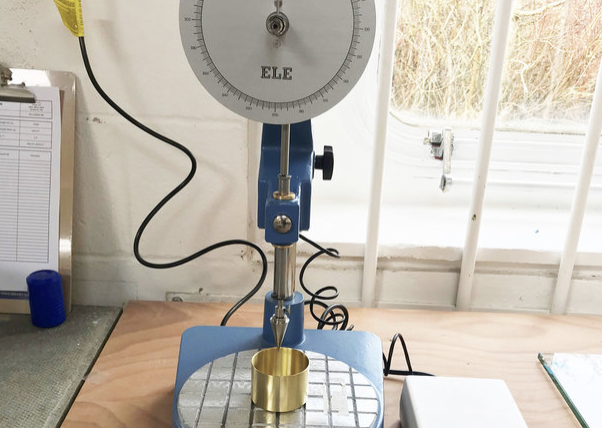
These classification measurements help characterise how a soil changes with water content. Hixtra uses suitable laboratory methods, including the fall cone approach for liquid limit. Results are often considered alongside natural water content and other geotechnical information.

A closer look
These classification measurements help characterise how a soil changes with water content. Hixtra uses suitable laboratory methods, including the fall cone approach for liquid limit. Results are often considered alongside natural water content and other geotechnical information.
UKAS accreditation applies to the particular methods listed in Hixtra’s current schedule, rather than every service. Ask us to confirm the accreditation status of the testing you require.
Hixtra in action
Working with Hixtra
From your first enquiry to your report, you’ll have practical advice on what to book, how to prepare and what happens next.
Share the site location, materials and testing specification. If you are unsure which test you need, we can help.
We agree the scope, access or sample requirements, availability and reporting arrangements before work starts.
Your results are reported for the agreed testing. Our team is on hand if you need to discuss the report.
Testing support across England & Wales
From individual site visits to ongoing testing programmes, we support construction, civil engineering and geotechnical projects across England and Wales.
Check availability for your site ↗Your questions
Practical answers on what this test is for, how to prepare and what you get back.
Ask us about your project →They describe the water contents at which a fine-grained soil changes how it behaves. The liquid limit is the water content at which it starts to flow and the plastic limit the water content at which it stops being mouldable and crumbles. The plasticity index is simply the gap between the two. A wide gap means a clay-rich soil that stays workable over a broad moisture range and moves as it wets and dries.
With a cone penetrometer. An 80 g cone with a 30 degree tip is released onto the surface of remoulded soil in a cup for five seconds, and the water content that gives a penetration of 20 mm is the liquid limit. The standard method takes readings at four different water contents and reads the limit off the plot. The Casagrande percussion apparatus is an accepted alternative where a specification calls for it.
By hand. A small piece of soil is rolled into a thread on a glass plate until it crumbles, and the plastic limit is the water content at which the thread first crumbles at a diameter of 3 mm. It is a simple test but a judgement-based one, so it is carried out on repeat portions and averaged. Soils that will not form a 3 mm thread at any water content are reported as non-plastic.
Commonly to BS 1377-2 or to BS EN ISO 17892-12, the Eurocode-era standard covering both the liquid and the plastic limit. Both allow the cone penetrometer and the Casagrande apparatus for the liquid limit. Some specifications also accept a one-point liquid limit rather than the full four-point determination, so tell us which standard and which variant your testing schedule names.
We need enough to yield roughly 200 to 300 g passing a 425 micron sieve, because the test is carried out on that fraction alone. For a clay that is a small bag; for a sandy or gravelly soil it can take several kilograms to get there. Do not oven dry it first. Pre-drying can change the limits of some clays irreversibly, so send it sealed at its natural moisture content.
The report says non-plastic and no plasticity index can be calculated. That is a valid result rather than a failed test: clean sands and gravels, and some rock flours and silts, have no plastic range to measure. If your specification sets a maximum plasticity index, a non-plastic result satisfies it. If it sets a minimum, or assumes a cohesive material, the result is telling you something useful about the soil.
The liquid limit and plasticity index are plotted together on a plasticity chart. Material plotting above the A-line is described as a clay and material below it as a silt, while the liquid limit sets the descriptive band: low below 35, intermediate 35 to 50, high 50 to 70, very high 70 to 90 and extremely high above 90. That is how a soil becomes, for example, a clay of high plasticity.
It signals a soil that shrinks and swells appreciably as moisture changes, which matters for foundation depth, for shallow services and for anything built near trees. NHBC guidance on building near trees works from a modified plasticity index, the plasticity index multiplied by the proportion of soil passing 425 microns, and takes volume change potential as high at 40 per cent or more, medium from 20 and low from 10.
Yes, regularly. Earthworks specifications classify fill partly on plasticity, and the Specification for Highway Works treats material with a liquid limit exceeding 90 or a plasticity index exceeding 65 as unacceptable. Plasticity is also read against the natural moisture content, since cohesive fill that is wet relative to its plastic limit will not compact and cannot be trafficked. Grading and moisture content are normally tested at the same time.
Preparation takes longer than the testing itself. The material has to be wet sieved through 425 microns and the fines recovered and brought back to a workable condition, which for a heavy clay can take several days before any limit is determined. A four-point liquid limit takes longer than a one-point. Sandy soils that yield little material passing 425 microns can need reworking. We confirm the expected timing before the work is booked.
Hixtra holds UKAS accreditation to ISO/IEC 17025 for the tests listed in its schedule of accreditation, number 8996. Accreditation is specific to the listed methods and scope, so it depends on the standard and the variant your specification names, given that the cone penetrometer and Casagrande methods are separate entries. Ask us to confirm the status of the testing you need and the report will state it result by result.
The material type and a description, the number of samples, the standard and method variant if your schedule names one, your preferred dates and the site postcode if samples need collecting. Say whether the plasticity index alone is required or the liquid limit and plastic limit are to be reported separately. Sample numbers and the preparation each one needs are the main things that move the price.
In our customers’ words
Independent feedback from the people we work with.
“Punctual, friendly and professional.”Read the full review ↗
“Perfect service and explained everything step by step.”Read the full review ↗
“Excellent service! Incredibly professional. Thankyou”Read the full review ↗
Customers come back to Hixtra
Read independent feedback from customers who have used our testing services.
4.8 / 5 on Trustpilot
“Punctual, friendly and professional.”
Lee Chippington · September 2026
Read this customer’s review ↗Same-day and next-day testing dates available. Tell us what you need and where, or call to check availability.