Understand your material
Establish the particle size distribution of soils, aggregates and engineered fill.
Soils & geotechnical laboratory testing
Establish the particle size distribution of soils, aggregates and engineered fill.
Same-day & next-day testing dates available. Call to check availability for your location and test requirements.
Practical testing. Experienced people. A service built around your project.
Quality, safety & professional standards
UKAS accreditation applies to the tests listed in our accredited schedule.
View our credentials ↗



Experienced people
Technical knowledge, with practical advice.
National coverage
Testing support wherever your project takes you.
A responsive service
Clear arrangements, from enquiry to reporting.
The right testing for your project
Practical advice, experienced testing staff and clear reporting. Establish the particle size distribution of soils, aggregates and engineered fill.
Speak to the team ↗Where this service helps
The right test helps answer a specific project question. We’ll agree the method and requirements with you before the work begins.
Establish the particle size distribution of soils, aggregates and engineered fill.
Agree the test method, sample condition and acceptance criteria before the work begins.
Use clear test records to support your project’s material and engineering assessment.
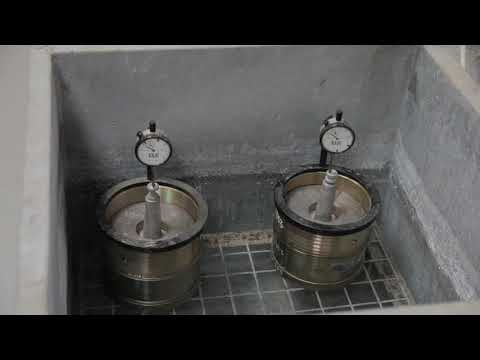
Hixtra can undertake wet or dry sieving and hydrometer analysis where appropriate. The required method depends on the material and the size range being assessed. A representative sample is essential when comparing a grading curve with specification limits.

A closer look
Hixtra can undertake wet or dry sieving and hydrometer analysis where appropriate. The required method depends on the material and the size range being assessed. A representative sample is essential when comparing a grading curve with specification limits.
UKAS accreditation applies to the particular methods listed in Hixtra’s current schedule, rather than every service. Ask us to confirm the accreditation status of the testing you require.
Hixtra in action
Working with Hixtra
From your first enquiry to your report, you’ll have practical advice on what to book, how to prepare and what happens next.
Share the site location, materials and testing specification. If you are unsure which test you need, we can help.
We agree the scope, access or sample requirements, availability and reporting arrangements before work starts.
Your results are reported for the agreed testing. Our team is on hand if you need to discuss the report.
Testing support across England & Wales
From individual site visits to ongoing testing programmes, we support construction, civil engineering and geotechnical projects across England and Wales.
Check availability for your site ↗Your questions
Practical answers on what this test is for, how to prepare and what you get back.
Ask us about your project →It tells you what proportion of the material by mass falls into each size fraction, from gravel and sand down through silt to clay. That is the single most useful description of a soil or an aggregate, because it governs how the material drains, how it compacts, whether it will pipe or filter and whether it meets the grading a specification demands.
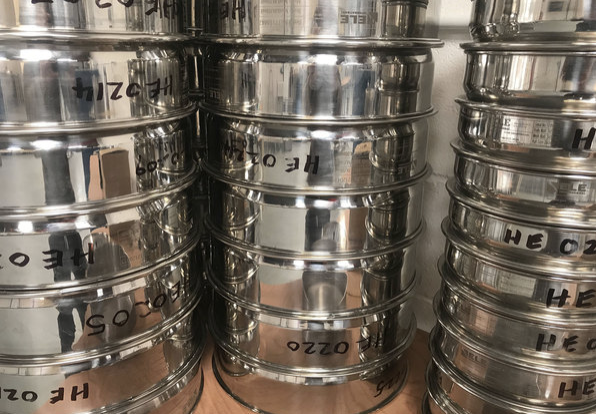
The sample is dried and weighed, washed over a 63 micron sieve to remove the fines, dried again, then passed down a nest of sieves of decreasing aperture on a shaker. The mass retained on each sieve is weighed and converted into a cumulative percentage passing. Where a significant proportion passes 63 microns, a sedimentation stage follows to split the silt and clay sizes.
Dry sieving is only reliable for clean granular material with very few fines. In anything with a fines content the silt and clay cling to the coarser grains and to the mesh, so dry sieving reports too little fine material and too much sand. Wet sieving washes the fines off first and gives the true picture. If you are unsure, assume wet sieving is needed and tell us what the material looks like.
Where the specification needs the silt and clay fractions separated, because sieving stops at 63 microns and cannot resolve anything finer. Sedimentation covers that range by measuring how quickly particles settle in suspension, either from hydrometer readings or by the pipette method. It is worth asking for when the material has a meaningful fines content and the result feeds filter design or a soil classification.
For soils it is commonly carried out to BS 1377-2 or to BS EN ISO 17892-4, which covers wet sieving, the hydrometer method and the pipette method. Aggregates and unbound mixtures are normally tested to BS EN 933-1. Highways work often points at a grading envelope in the Specification for Highway Works rather than naming a test method, so send the clause as well as the standard.
The largest particle present sets it, and the quantities climb quickly. Roughly 100 g covers a sand, silt or clay, 500 g a material with particles to 10 mm and 2 kg one with particles to 20 mm. Material up to 37.5 mm needs something like 14 kg, and up to 63 mm around 40 kg, which has to arrive split across several bags to keep each within a safe lifting weight.
As a grading curve: percentage passing on the vertical axis against particle size on a logarithmic horizontal axis, with the percentage passing each sieve tabulated alongside. Yes, the upper and lower limits of your specified envelope can be overlaid on the same chart so compliance reads directly off it. Send the envelope with the enquiry and it will appear on the report rather than having to be checked separately.
They describe the shape of the grading curve in two numbers. The uniformity coefficient is D60 divided by D10, so a high value means a wide spread of sizes and a value near one means a single-sized material. The coefficient of curvature, D30 squared divided by D10 times D60, shows whether the curve is smooth or has a gap in it. Well graded material compacts densely; uniform material drains freely.
Sampling is the usual culprit before the material is. Coarse and fine particles separate when a stockpile is built, tipped or spread, so a sample scooped from one spot can badly misrepresent the load. Beyond that, handling and compaction break down weaker aggregates and generate fines, and material can pick up contamination at the point of delivery. Resample properly before condemning the source.
Usually, yes. Grading, moisture content, plasticity and particle density form the standard classification suite and they are read together: grading tells you what the material is made of, plasticity how the fine fraction behaves and moisture content the state it is in. Earthworks acceptability and pavement foundation assessments normally need more than one of them, so send enough material for the whole set at once.
Hixtra holds UKAS accreditation to ISO/IEC 17025 for the tests listed in its schedule of accreditation, number 8996. Accreditation is specific to the listed methods and scope, and the soils and aggregates grading methods are separate entries, so the answer depends on which method your specification names. Ask us to confirm the status of the testing you need, and the report will state it test by test.
The number of samples, the largest particle size and whether a sedimentation stage is needed. Coarse material means a much bigger sample, more washing and drying and considerably more handling, so a 63 mm grading is a different job from a sand. Adding the hydrometer or pipette stage adds preparation and time. Send the material type, approximate quantities, the specification envelope and your dates for a price.
In our customers’ words
Independent feedback from the people we work with.
“Punctual, friendly and professional.”Read the full review ↗
“Perfect service and explained everything step by step.”Read the full review ↗
“Excellent service! Incredibly professional. Thankyou”Read the full review ↗
Customers come back to Hixtra
Read independent feedback from customers who have used our testing services.
4.8 / 5 on Trustpilot
“Punctual, friendly and professional.”
Lee Chippington · September 2026
Read this customer’s review ↗Same-day and next-day testing dates available. Tell us what you need and where, or call to check availability.