Hixtra · LWD testing in London

LWD testing in London.

Lightweight deflectometer testing for London sites. The equipment is carried by hand and needs no reaction vehicle, so it reaches basements, courtyards, podium decks and plots that a loaded lorry never could, and gives a stiffness reading in minutes.

Talk to Hixtra →020 7993 5733

Same-day and next-day dates are often available for London, with results normally reported the same day. Call to check availability.

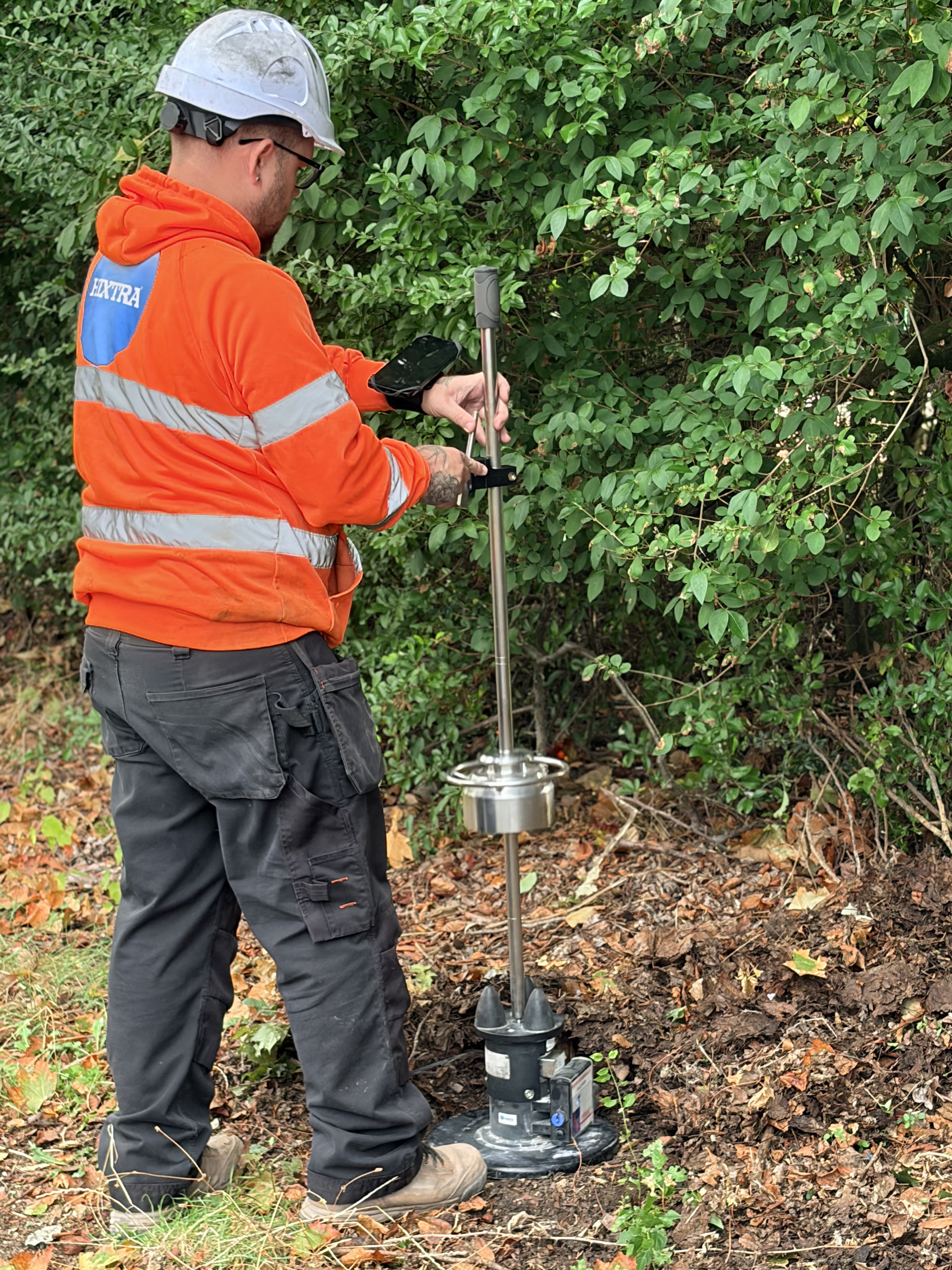
Hixtra technician carrying out a light weight deflectometer test beside a hedge

Quality, safety & professional standards

Expertise you can check.

UKAS accreditation applies to the tests listed in our accredited schedule. Ask us for the current scope before you book.

Understand our accreditation →
UKAS testing · 8996
CHAS accredited contractor
SSIP scheme assessed
AGS member

Goes where a lorry cannot

Hand carried equipment suits basements, courtyards, podium decks and constrained city plots.

Minutes per position

A quick test means less time in the way on a busy site and more positions covered.

Reported the same day

Results normally reach your engineer the same day as a PDF, position by position.

LWD testing in London

Where an LWD earns its place on a London site.

On London sites, access governs everything. Getting a plate bearing reaction vehicle to a test position can take longer than the test. An LWD avoids that, which makes it the practical way to check capping, sub-base and fill in tight places. It does not replace a plate test where a design depends on one, so it helps to know where it fits.

01 / PLACED LAYERS

Capping, sub-base and fill

The LWD works best on granular layers with a real elastic response: capping over London Clay, Type 1 under slabs and paving, granular build-up over podium and transfer slabs, and backfill to basements and services. Explore LWD testing →

02 / PLATE BEARING

Where a plate test is still needed

Crane hardstandings and piling mats are designed to a bearing pressure and checked by plate bearing at the outrigger and track positions. An LWD grid across the rest of the mat shows whether it is uniform. Explore plate bearing testing →

03 / DCP

Looking deeper with DCP

An LWD sees only the top 300 to 450 mm. On made ground, backfilled basements and the Thames marshes, a DCP beside any odd reading shows what lies beneath the layer being tested. Explore DCP testing →

What London ground means for LWD testing.

CBR testing and plate bearing testing answer different questions from an LWD, and on London ground it pays to choose deliberately. London Clay is firm to stiff when undisturbed and softens quickly at formation level under rain and plant. Soft cohesive soil is the weak point of the LWD, so readings directly on wet clay are unreliable, and the method belongs on the capping that specifications here nearly always call for. On the River Terrace gravels along the Thames and the Lea it can be used at formation. On inner London made ground, with its rubble, old footings and soft trench backfill, results vary sharply, and a quick grid of LWD readings is a good way to find the soft areas before they are built over. On the marshes at Rainham, Erith and Dartford, a platform can read well while sitting on peat the test never reaches.

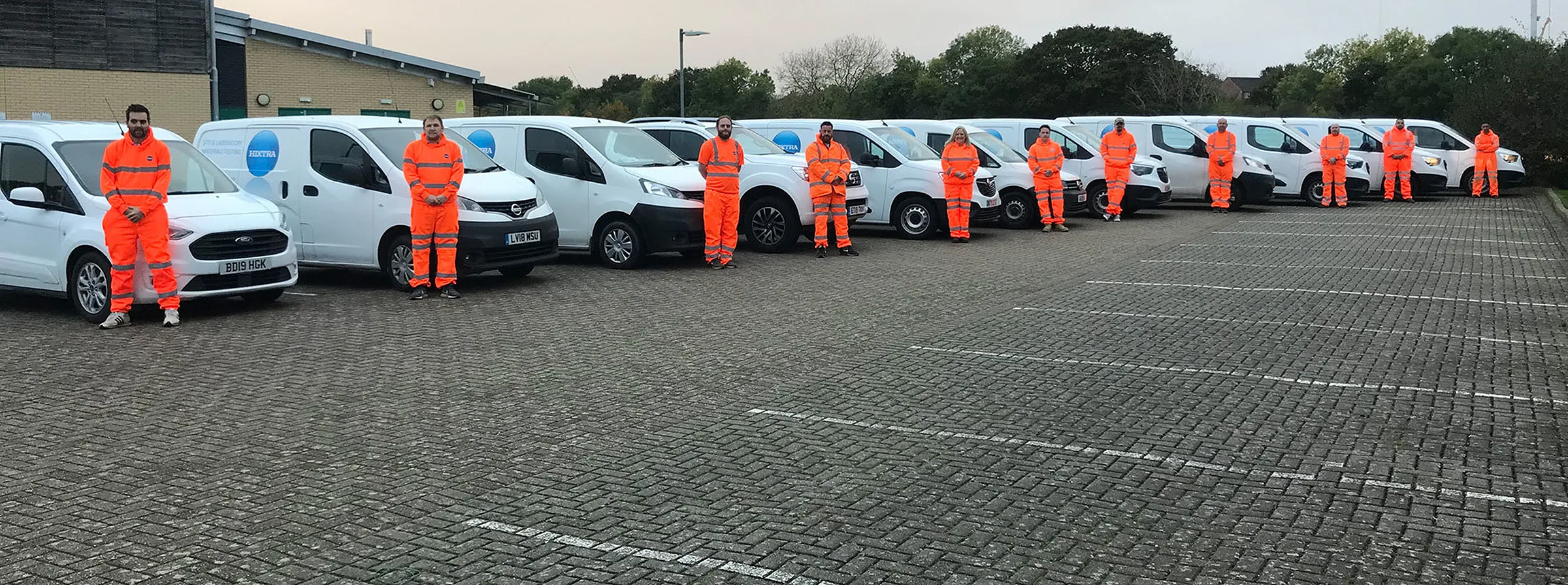
Hixtra vans and staff lined up outside
Ground testing carried out to an agreed method.Hixtra project photography.

Questions people ask

Your questions, answered.

Practical answers for planning and booking LWD testing in London.

Ask us about your project →
How quickly can you carry out LWD testing in London?

Same-day and next-day dates are often available, subject to the schedule. We do not guarantee an attendance time, because the M1, the M25 and the roads inside the North Circular decide it. An LWD visit is easier to plan than plate bearing, as there is no reaction vehicle to route through the city. Ring 020 7993 5733 with the postcode.

What does an LWD test measure?

A lightweight deflectometer measures the stiffness of the surface layer. A weight is dropped down a guide rod onto a loading plate and a sensor records how far the surface deflects. A 10 kg weight falling onto a 300 mm plate is typical, with a few seating drops to bed the plate followed by measuring drops that are averaged. The result is a dynamic surface modulus in megapascals, calculated from the force applied and the deflection it produced. The whole kit fits in a small van and is carried to the position by hand.

Can you test in a basement or on a podium deck?

Yes. That is where the method is most useful in London. The equipment is carried by hand down a stair or scaffold, so basement formations, granular build-up over podium and transfer slabs, internal courtyards and landscaped decks can all be tested. Tell us about access routes, headroom and any permit requirements when you book.

Can you use an LWD directly on London Clay?

Not reliably when it is wet. London Clay at formation deforms plastically under the falling weight and gives little elastic recovery for the equipment to read, so results scatter. Specifications on the clay normally assume the wet case and call for a capping layer, and that layer is what the LWD should be testing. For the clay itself, use a CBR.

Will it replace a plate bearing test for our crane pad?

No. A crane hardstanding or piling mat is designed to a bearing pressure, and the check is a plate bearing test at the positions the outriggers or tracks will load. Most designers will not accept an LWD as a substitute. What it can do is show that the rest of the mat is as good as the positions that were plate tested.

What stiffness should my capping or sub-base achieve?

Your specification or designer sets it. For pavements, DMRB CD 225 defines foundation classes by surface modulus, starting at 50 MPa, and the specification says which class applies. For slabs, podium build-ups and hard landscaping the engineer usually sets a project value. Tell us the target and the report shows each position against it.

Which standard is LWD testing carried out to?

There is no single British Standard for the lightweight deflectometer. Testing usually follows the equipment manufacturer’s procedure alongside a recognised method such as ASTM E2583. On highway schemes the requirement comes from the specification, with performance testing of pavement foundations covered by Series 800 of the Specification for Highway Works.

How deep does an LWD test assess?

Roughly one to one and a half plate diameters, so the top 300 to 450 mm with a 300 mm plate. It checks the layer you have placed. It will not tell you about a backfilled basement two metres down or peat under a marsh platform, which is why a DCP or the ground investigation is needed alongside it on that kind of ground.

Can LWD be used to check trench and service backfill?

Yes, where the backfill is granular. It is a quick way to check that each layer of backfill to services, drainage runs and basement walls has been compacted consistently, in places where no larger equipment will fit. The trench needs to be wide enough to seat the 300 mm plate flat, and your specification should say what value is acceptable.

Can an LWD result be converted to a CBR?

It can be estimated, but dynamic stiffness and direct CBR are different measurements and the relationship depends on the material. Any conversion must be appropriate to the material and agreed for the project, and reported as derived. If a borough or adopting authority wants a CBR, a CBR test is the cleaner answer.

Is your LWD testing UKAS accredited?

Hixtra holds UKAS accreditation to ISO/IEC 17025 under schedule number 8996. Accreditation is granted method by method, not to the company as a whole, so it applies only to the tests listed on our current schedule. Ask us to confirm the accreditation status of LWD testing when you enquire, particularly if your specification requires accredited results, and we will tell you before you book.

What does LWD testing in London cost?

Every visit is quoted from the site postcode. In London the saving is in time and access: no reaction vehicle to route, no waiting for a clear path to each position, and only minutes per test. The price depends mainly on the time on site. Send the postcode, the area to be tested, any restricted hours and your dates.

Do you have an office in London?

No. There is no Hixtra office in London. The 020 number rings through to the laboratory in Milton Keynes and every team travels from there. Coverage means we attend, not that we keep staff or kit in the borough.

Hixtra in action

See the testing in practice.

Explore our films →
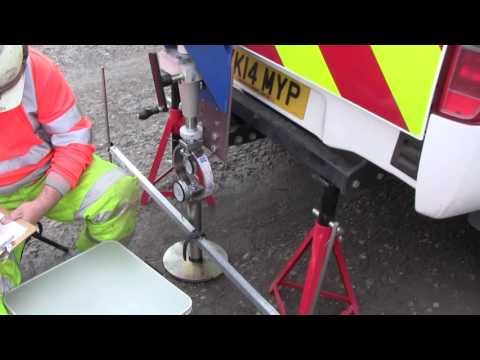
In-situ CBR testing — Hixtra's original filmWatch the film

In-situ CBR testing

See how bearing strength is tested directly on site.

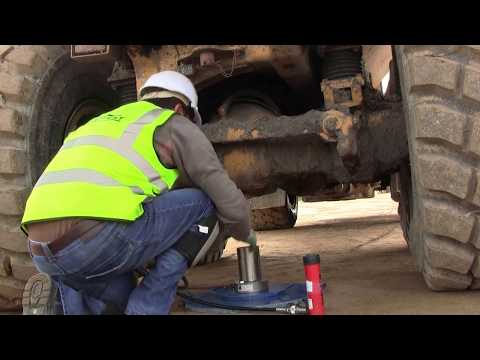
Plate bearing testing — Hixtra's original filmWatch the film

Plate bearing testing

Watch a plate bearing test being carried out on prepared ground.

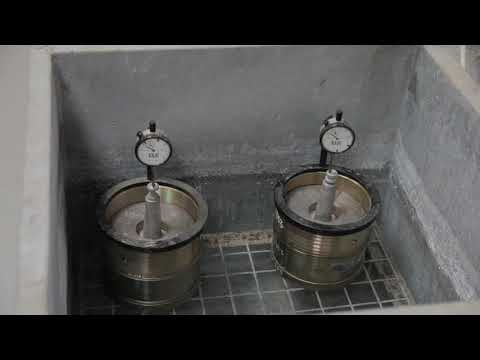
Soaked laboratory CBR testing — Hixtra's original filmWatch the film

Soaked laboratory CBR testing

Follow the laboratory process used to assess a prepared soil specimen.

In our customers’ words

A reputation built
on the work we do.

Trustpilot 4.8 / 5 ↑

Independent feedback from the people we work with.

★★★★★

Lee ChippingtonTrustpilot · September 2026

Read the full review →
★★★★★

terry heatherTrustpilot · August 2026

Read the full review →