Understand your material
Determine the density of the solid particles within soils and aggregates.
Soils & geotechnical laboratory testing
Determine the density of the solid particles within soils and aggregates.
Same-day & next-day testing dates available. Call to check availability for your location and test requirements.
Practical testing. Experienced people. A service built around your project.
Quality, safety & professional standards
UKAS accreditation applies to the tests listed in our accredited schedule.
View our credentials ↗



Experienced people
Technical knowledge, with practical advice.
National coverage
Testing support wherever your project takes you.
A responsive service
Clear arrangements, from enquiry to reporting.
The right testing for your project
Practical advice, experienced testing staff and clear reporting. Determine the density of the solid particles within soils and aggregates.
Speak to the team ↗Where this service helps
The right test helps answer a specific project question. We’ll agree the method and requirements with you before the work begins.
Determine the density of the solid particles within soils and aggregates.
Agree the test method, sample condition and acceptance criteria before the work begins.
Use clear test records to support your project’s material and engineering assessment.
Particle density excludes the void spaces between particles. It can support calculations involving soil composition and air voids when used with the other required measurements. Tell us the material and intended calculation so the appropriate method can be confirmed.

A closer look
Particle density excludes the void spaces between particles. It can support calculations involving soil composition and air voids when used with the other required measurements. Tell us the material and intended calculation so the appropriate method can be confirmed.
UKAS accreditation applies to the particular methods listed in Hixtra’s current schedule, rather than every service. Ask us to confirm the accreditation status of the testing you require.
Hixtra in action
Working with Hixtra
From your first enquiry to your report, you’ll have practical advice on what to book, how to prepare and what happens next.
Share the site location, materials and testing specification. If you are unsure which test you need, we can help.
We agree the scope, access or sample requirements, availability and reporting arrangements before work starts.
Your results are reported for the agreed testing. Our team is on hand if you need to discuss the report.
Testing support across England & Wales
From individual site visits to ongoing testing programmes, we support construction, civil engineering and geotechnical projects across England and Wales.
Check availability for your site ↗Your questions
Practical answers on what this test is for, how to prepare and what you get back.
Ask us about your project →Particle density is the mass of the solid grains divided by the volume those grains occupy, with the void spaces between them excluded. Bulk density and dry density describe a soil as placed, voids and all, so they change with compaction. Particle density describes the mineral material itself, which is why the same soil returns the same value whether it is loose or well compacted.
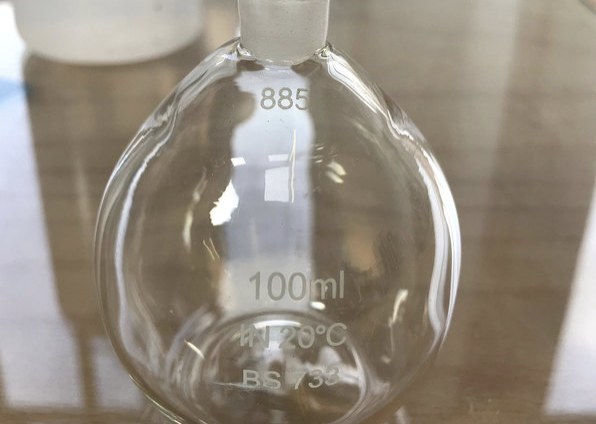
By displacement. A known mass of oven-dried material is placed in a vessel of known volume, the vessel is filled with water and weighed, and the volume of water displaced gives the volume of the solid particles. Getting all the trapped air out is the critical part, which is why the vessel is shaken, stirred or placed under vacuum before the final weighing.
They are closely related but not identical. Particle density is a density with units, usually reported in Mg/m3, while specific gravity is the dimensionless ratio of that density to the density of water, so the two are numerically almost the same. Older specifications tend to say specific gravity and current ones particle density. Neither should be confused with relative density, which describes how tightly a granular soil is packed.
It depends on the grading of the material. The small pyknometer method suits fine soils passing a 2 mm sieve, the large pyknometer handles soils containing gravel and the gas jar method is used for coarser granular material. Aggregates are a separate case and are normally tested by the procedures written for them. Tell us the material and the calculation the result feeds and we will confirm the method.
For soils it is commonly carried out to BS 1377-2 or to BS EN ISO 17892-3, the Eurocode-era pyknometer method. Aggregates are usually tested to BS EN 1097-6, which covers particle density and water absorption together. Specifications vary in which they name, and because the methods can give slightly different values for the same material it is worth confirming which one your project requires.
Not a great deal for a fine soil. Around 50 g passing 2 mm is enough for the small pyknometer method, while the gas jar method needs roughly 400 g of fine-grained material or 800 g where the sample is coarse. Gravels and aggregates need more again. Send a generous sample if the same material is also going for grading or plasticity work.
Most mineral soils fall between about 2.60 and 2.75 Mg/m3, with quartz sands close to 2.65. Values below that range usually indicate organic content, shell or a porous, lightweight aggregate. Values above it point to heavy minerals, ironstone or slag. A figure well outside the usual range is worth checking against the description of the material before it is used in a calculation.
It is the link between mass and volume for the solid phase, so it is needed to work out void ratio, porosity, degree of saturation and air voids. The air voids lines drawn on a compaction plot depend on it, and a measured value is preferable to the 2.65 Mg/m3 commonly assumed in its place. It is also needed to calculate settling velocities in a sedimentation analysis.
No. Compaction and moisture change how much void space there is between the particles, and they change bulk and dry density, but they do not change the density of the grains themselves. The things that shift particle density are a change in the mineral make-up of the material, the presence of organic matter, or a sample that draws on more than one source.
The two usual explanations are the material itself and air left in the test. Organic matter, shell, chalk and porous lightweight aggregates pull the value down, while ironstone, slag and heavy minerals push it up. A sample that mixes two different materials returns an average representing neither. Send us the material description or a photograph and we can say whether the value looks consistent with it.
Yes. Hixtra holds UKAS accreditation to ISO/IEC 17025 for the tests listed in its schedule of accreditation, number 8996, and reports state the method used and the accreditation status of each result. Accreditation is specific to the listed methods and scope, so whether a given particle density method is covered depends on the method your specification names. Ask us to confirm the position before you book.
Send the material type, the number of samples, the method or specification if one is named and your preferred dates, with the site postcode if samples need collecting. Tell us the largest particle size, because that decides the method and how much preparation is involved. Cost is driven mainly by sample numbers and preparation, so running it with other classification tests on the same material is usually more economical.
In our customers’ words
Independent feedback from the people we work with.
“Punctual, friendly and professional.”Read the full review ↗
“Perfect service and explained everything step by step.”Read the full review ↗
“Excellent service! Incredibly professional. Thankyou”Read the full review ↗
Customers come back to Hixtra
Read independent feedback from customers who have used our testing services.
4.8 / 5 on Trustpilot
“Punctual, friendly and professional.”
Lee Chippington · September 2026
Read this customer’s review ↗Same-day and next-day testing dates available. Tell us what you need and where, or call to check availability.